Categories
Case Studies and Articles

Farm Property and the CRT

Farm Property and the CRT

Farm Property and the CRT – A Better Way to Preserve Family Wealth

Although there has been a lot of press about the reduction of the capital gains tax this year, the tendency for most owners of significantly appreciated assets is to hold them, rather than sell and accept any tax liability. Most of us in the estate planning community recognize that anIRC § 664Charitable Remainder Trust offers clients several creative, legal and ethical ways to minimize these tax burdens. Although many financial service professionals promote the CRT as a “capital gains bypass trust”; in reality, the trust offers more than the opportunity to reduce just the capital gains tax. Properly integrated into an estate plan, a CRT can be used to assist family business transition planning and control “social capital” by deciding on a voluntary – self directed gift instead of an involuntary tax overseen by others. Add to those advantages the ability to create a family controlled philanthropy preserving influence benefits of family wealth and you have a dynamic plan. The problem is that we typically approach estate planning processes piecemeal and don’t put together a complete package, one that goes beyond estate planning and actually encompasses wealth preservation planning. A classic case study follows. This IRC§664 Trust deals with creeping suburban sprawl and the conversion of farmland into shopping center parking lots.

image

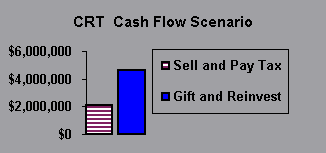
John and Betsy Moore, ages 62 and 59, have an 80 acre parcel of ground that has been used primarily for corn and soybean production for their family farm. Recently, they have been offered a price based on a square footage figure for their land, acreage that they bought years ago for $500/acre. Since the Moore’s children are no longer active on the farm, the questions about preserving value and using assets to provide for a retirement have popped up. The Moore’s view this as an opportunity to create retirement security, since neither managed to set aside much in their IRAs. As they reviewed the tax liability with their accountant, he suggested that they call me to run a sample scenario*. Compare what would happen if they kept the land and continued to farm it, or sold it and paid the tax, reinvesting the balance, or transferred it to a CRT. The following chart seems self-explanatory, and they decided it made more sense to utilize the CRT as a retirement and tax planning tool and keep their assets in the community. In this case, they chose to fund a local hospital, a nursing home and a college in a nearby town, rather than let the IRS collect unnecessary tax and have the funds redirected to other non-local causes.

Moore Farm CRT Strategy

(see our sitehttp://members.aol.com/CRTrust/CRT.htmlfor other tools)

Keep Asset at Work and Pass to Heirs (A) Sell Asset and Reinvest the Balance (B) Gift Asset to CRT and Reinvest (C)
Fair Market Value of 80 Acres of Development Land

$800,000

$800,000

$800,000

Less: Cost of Sale

$32,000

$32,000

Adjusted Sales Price

$768,000

$768,000

Less: Tax Basis

$40,000

Equals: Gain on Sale

$728,000

Less: Capital Gains Tax (federal and state)

$218,400

Net Amount at Work

$800,000

$549,600

$768,000

Annual Return From Asset Valued at $800,000 @ 3.5% (land continues appreciating at 6%)

$28,000

Annual Return From Asset Reinvested in Balanced Acct @ 10%

$54,960

Avg. Annual Return From Asset in 6% CRUT Reinvested @ 10%

$88,189

After-Tax (31%) Spendable Income

$19,320

$37,922

$60,850

Statistical Number of Years for Cash Flow for Joint Lives

31

31

31

Taxes Saved from $210,016 Deduction at 31% Marginal Rate

$65,105

Tax Savings and Cash Flow over Joint Life Expectancies

$598,920

$1,175,594

$1,951,461

Total Increase in Net Cash Flow Compared to Original Asset

$576,674

$1,352,541

Value of Assets After Estate Tax (at 55%) Paid

$2,678,764

$302,280

$0

Value of Charitable Remainder to Family Sponsored Charity

$2,590,566

Optional Use of Wealth Replacement Trust (WRT) to Offset Gift**

$3,968,815

Total Value to Family (Income and Heirs’ Inheritance)***

$3,327,684

$1,477,874

$5,144,409

Hypothetical evaluations are provided as a professional courtesy to members of the estate planning community. Feel free to call for suggestions.

** Insurance premium of $25,028 for duration of joint life expectancy was used so there would be no difference between options B and C in the net cash flow ($775,867 was removed from option C cash flow to fund WRT). Policy used was a variable universal type survivor life policy with investment options at 10% like alternative investment assumptions. Funded with Crummey gifts to ILIT. All investment returns are hypothetical with no guarantee of future performance.

*** Value to family does not include the appreciated value of the charitable gift to family philanthropic interests.


© 1997, Henry & Associates, Springfield, Illinois

Henry & Associates

Gift & Estate Planning Services

Categories
IRS Information, Regulations and Commentary on Charitable Legal Issues

Making Your Charitable Trust Mimic a Pension – Vaughn Henry & Associates

Making Your Charitable Trust Mimic a Pension – Vaughn Henry & Associates

Make that Charitable Trust Act like a Pension

Vaughn W. Henry © 1999

If you think Patrick Henry’s, “taxation without representation” is meaningful, imagine how he’d feel about our “taxation with representation”.

Once upon a time, pension experts promoted tax deferred retirement plans as a way to grow an estate. Their sales pitch was, “whatever you don’t use in retirement will be available for your kids.” Then, when it became apparent business owners were setting aside too much for themselves, the Department of Labor and ERISA/IRS regulations mandated a whole list of rules that made discriminatory retirement planning a thing of the past. To heap further problems on the pension owner, Congress changed the estate tax treatment of retirement accounts in 1981 to eventually make them completely taxable at both the income and estate tax level by 1986. In some areas of the country, it was possible for a family to owe more than 100 cents tax on every inherited dollar, so in today’s planning environment, a different approach to retirement planning has become more popular. Enlightened estate planning promotes the concept of regaining control over dollars that otherwise are lost to the tax system.

Depending on the performance and nature of the investments used, a charitable retirement unitrust might make use of new flip trust regulations and have more income with capital gains treatment on the deferred income stream. The alternative approach is to use a specially designed deferred annuity inside a §664 charitable remainder trust (CRT) to more precisely control the timing and recognition of distributable net income (DNI) and make it a spigot trust. WIFO* (worst in, first out) four tier trust accounting can be manipulated if there is a complete understanding of the investment choices inside CRT funded with cash.

Gerald (50) and Susan Warren (49) have a successful partnership as business brokers and consultants. While they have a fully funded profit sharing and pension plan, they decided to look into other retirement planning tools that offered a different sort of control. The Warren’s dissatisfaction with their existing plan became apparent after they saw how the required minimum distributions would force out income when they wouldn’t need it and the eventual confiscation of their savings. Originally designed to provide security in retirement and create an estate for their heirs, instead after a series of legislative changes, it looked like the IRS is the major beneficiary of their retirement planning.

With a degree in law, Gerald looked into using a charitable trust to mimic his pension plan and decided to make use of a net income/make-up charitable remainder unitrust (NIMCRUT). Although not every contributed dollar is 100% deductible, the flexibility and personal satisfaction of knowing their social capital dollars will be redirected was motivating. Once they acknowledged that taxes are a form of involuntary philanthropy, the §664 CRT made more sense within their master plan and they proceeded with the trust. Since Gerald plans to work full-time at least through age 68, the Warrens decided to set aside $50,000 a year for contributions to their retirement unitrust. Over the next 18 years, a total of $900,000 will be saved inside a tax-exempt trust that generates $163,012 in tax deductions. When the retirement CRT or spigot trust opens up in the 19th year, the Warrens can expect to receive $4.33 million (based on past investment performance) in after-tax income during their retirement. After Gerald and Susan pass away, at their joint life expectancy, the trust will transfer $7.81 million to their community foundation’s donor advised account for their children to manage and distribute. This trust, combined with a wealth replacement trust for their heirs, will leave the family in control of the Warren estate and produce a “Zero Estate Tax Plan” that suits their planning goals with a family financial philosophy of wealth preservation and charity.

For those who would prefer to use a conventional pension plan, if the same NIMCRUT input assumptions are used, the tax liability at life expectancy would be a staggering $5.899 million and the total spendable income would not be significantly different. Clearly, a charitable trust as a retirement planning tool is worth consideration for individuals with charitable intent and a desire to retain control of family wealth.

Pension §664 Trust
Deductibility Full Partial
Tax Advantaged Growth Yes Yes
§415 Limitations Yes No
Assets Subject to Estate Tax Yes No
Non-Discrimination Rules Yes No
Early & Late Retirement Penalties Yes No
Required Minimum Distributions Yes No
Taxation of Distributions Ordinary Income WIFO* Acctg.
Benefits to Heirs Yes Optional
Heirs’ Benefits Taxed Yes No
Categories
Case Studies and Articles

Charitable Education Trusts for Grandkids – Henry & Associates

Charitable Education Trusts for Grandkids – Henry & Associates

Charitable Education Trusts for Grandkids

Vaughn W. Henry © 1999

“There are two systems of taxation in our country:

one for the informed and one for the uninformed.”

Honorable Learned Hand (1872-1961)

Many planners believe a CRT only works for older income beneficiaries. However, there is a way for a family to fund both philanthropic goals and meet educational needs. How and why does it work? It takes the tax-free compounding of assets and uses an IRS §664 “spigot trust” to precisely control income. In the Watson family, Richard and Pam have several preteen grandchildren to help through college. However, they didn’t want to use the traditional gifting via the UTMA/UGMA approach. Instead, a CRT lets them ensure their own philanthropic legacy and still provide funds for educational expenses. In the simplest terms, Richard created individual trusts to benefit each of his grandchildren by transferring $50,000 of appreciated telephone company stock to each charitable remainder trust. By naming his granddaughter, Hannah, as the sole income beneficiary of the first “term of years” trust, he started the college funding plan last year. While most charitable trusts are intended to last over a life expectancy, this trust is designed to terminate after just 10 years and pass the remainder to the family’s charity, a donor advised fund at the local community foundation. By creating a 6% payout NIMCRUT, Richard will receive an income tax deduction of $27,858 for his $50,000 gift to the trust. Since the trust only operates for a limited time, it allows Richard and Pam to jointly make an “income interest” gift to Hannah valued at just $22,142, allocated to lifetime and generation skipping exempt gifts. Since Hannah is only 11 years old, she’s not expected to need college funding for 7 more years, so the investment will be structured to produce only growth and no “distributable” income for the first six years, allowing the CRT to grow. When Hannah turns 18, the “spigot trust” modifies the investment and pays out income for tuition at her lower marginal income tax rate.

While the trust’s performance depends on the underlying investments, it’s very important to select a tool that allows precise control of income recognition. The other common problem with a NIMCRUT is the inability to actually access the make-up account without compromising the total return portfolio of investments. “Spigot trusts” are inherently complex, so a careful review of all the options should be made. Of the many products available to the Watson’s financial advisor, a well-diversified portfolio of equities for growth may be found in a number of deferred annuities. Some advisors might question putting an ordinary income producing tax deferred product into a tax-exempt trust, but there are compelling reasons to do so, if the annuity has been especially designed to work within a CRT. The “garden variety annuity” will have too many design flaws to work properly inside a NIMCRUT, but if the document allows annuity use, it should be considered. Ordinary income tax treatment of distributions isn’t likely to be an issue for such young income beneficiaries with their already low tax rate. The other usual concerns about pre 591/2 restrictions and non-natural persons owning annuities aren’t an issue inside the exempt CRT; instead, understand why the “recognition” of annuity income works in favor of the “spigot trust”.

Yr.

Watson’s Tax Deduction

Yearly Value of NIMCRUT

Pre-Tax Income to College Aged Granddaughter

$27,858

$50,000

$0

$56,000

$0

$62,720

$0

$78,676

$0

$88,117

$0

$98,691

$0

$100,534

$10,000

$102,098

$10,500

$103,350

$11,000

10

$104,761

$10,991

Given the time frame of the trust, a growth-oriented set of investments should be selected. If it performs better than expectations, Hannah will receive even more income for college expenses and the charity will benefit by having a larger remainder. As designed now, the charity should receive $104,761 while Hannah will have $42,491 of income, taxed at her lowest marginal rate, to help her pay tuition and board. The advantage to this technique for the Watson’s estate plan is that it:

  • removes an appreciating low basis asset from the estate without incurring capital gains liabilities
  • funds a significant growth asset without significant gift or generation skipping tax liabilities
  • keeps control of assets that otherwise would be taxed and returns them to a family influenced charity
  • creates an income tax deduction for a higher income older generation, with five more years of tax relief if the deductions can’t all be used in the first year

It’s not a technique for all clients or donors, but in the right situation, it works well. For a hypothetical evaluation, have our office run an illustration.

Categories
Case Studies and Articles

Partnering a CLAT and a Stretch IRA – Vaughn W. Henry & Associates

Partnering a CLAT and a Stretch IRA – Vaughn W. Henry & Associates

Partnering a CLAT and a Stretch IRA

Janet Bari (67), a professor emeritus of the local university’s art department, and her husband, Virgil (68), are typical Midwesterners.  They live modestly on $22,000 of social security income and what Janet makes by selling handmade jewelry and sculptures.   They own their country home, have no debts, pay cash for all of their purchases and avoid any sort of an ostentatious lifestyle.  She and Virgil married twenty years ago and each have children from previous marriages; both have a desire to preserve assets for their children, grandchildren and still provide for a degree of comfort and security in retirement.

Janet jumped onto the mutual fund bandwagon long before it became popular and regularly set aside savings in her IRA and 403(b) retirement plan, and has since accumulated over $1 million in tax deferred savings.  After realizing that she was also creating a potential IRD (income in respect of a decedent) tax trap, she redirected her on-going savings program to non-qualified equity accounts and has been pleased with the 14%+ returns over the last twelve years and her investment account has since grown to $500,000.  Always a big supporter of charitable causes, she and Virgil regularly give $5,000 to $15,000 away annually, even though their accountant has warned them that they can’t make complete use of the annual charitable deductions on their tax return.

When asked about goals and priorities, Janet said she hoped to leave each child with a level of financial support that wouldn’t be a disincentive to work, but would encourage heirs to develop their own business and philanthropical interests.  She wanted her family to receive the proceeds of her investment account, and although already making numerous $10,000 annual exclusion gifts, she was unwilling to make significant lifetime gifts to her heirs now and use up her applicable exclusion amount (unified credit).  Janet also expressed concern about helping a disabled granddaughter and a desire to protect her retirement plan assets from unnecessary taxation at death.

Of the many solutions proposed to her, the following scenario seemed to make the most sense.  It was easy to implement, provided a lot of flexibility and allowed her to make use of her retirement plan assets in a tax efficient fashion.  Since she hadn’t reached her required beginning date of 70½ years of age, Janet was able to take her $1 million in retirement plan assets and break the account up into seven different Individual Retirement Accounts (IRA) naming different family members as beneficiaries to each.  This strategy allowed her to have a longer payout when calculating the minimum required distributions (MRD), thus stretching out the payments over joint life expectancies that included some very young beneficiaries.  By stretching the payments out and by taking all the required distributions from just one $600,000 IRA account, the one she and her spouse shared, this allowed the six remaining accounts of $50,000 to $100,000 to continue compounding in a tax-deferred environment.  Since she was concerned about one granddaughter’s disability and future financial needs, Janet chose to fund that girl’s IRA at a higher level than those naming other grandchildren as beneficiaries.

Her advisor reminded her often that beneficiary designations can be modified, so if Janet has need of funds, she can always accelerate her withdrawals from any or all of her accounts, and this provides for adequate income security.  While Janet has no need of additional retirement income now, she has invested her seven IRA accounts in equity mutual funds and fully expects that they will continue to grow even after she’s forced to commence distributions.  She also named a charity to receive any balance in her primary IRA, limiting the IRD exposure while still providing for her husband, should he survive her.

To continue funding her charitable interests, a 5% non-grantor charitable lead annuity trust (CLAT) was established with the $500,000 investment account.  Since it has historically produced annual income and appreciation in excess of 14%, it was assumed that it could sustain a yearly gifting program of $25,000 and still have the capacity to grow over a twenty-year period of time.  The CLAT, a tax paying trust, can make charitable contributions and offset any earned income as a stand-alone taxable entity and make use of charitable deductions that Janet’s personal tax return cannot claim because of her AGI limitations.  By making distributions to a community foundation, Janet, as CLAT Trustee, can redirect the proceeds through a donor advised fund to charities of interest to the Bari family.  The foundation offers the Bari family the ability to accommodate any changes in their charitable contributions through their donor advised fund as family needs evolve over the years.  If Janet passes away before the twenty-year term expires, her children can step in and continue offering advice as to the direction of philanthropic support the trust will provide in the community.  If the trust pays out $25,000 annually and continues its historic performance for the duration of the trust’s term, there will be between $3 million and $7 million in the account that will pass nearly tax free to the heirs as if it used only $255,750 of Janet’s unified credit.  This is very efficient discounting and will provide the heirs with the resources for security and an opportunity to create their own remainder trusts in the future (see detailed flowchart).

flowchart1A CLAT can be easily described as a “deferred inheritance trust” and this offers the Bari family a degree of certainty as to when assets will be available to both charity and family members.  For the truly philanthropic, this plan offers donors a very useful means of passing assets to heirs in predetermined amounts, especially when insurance and wealth replacement trusts may not be economically viable options.
CONTACT US FOR A FREE PRELIMINARY CASE STUDY FOR YOUR OWN CRT SCENARIO

Categories
Case Studies and Articles

The FLIP CRUT Charitable Trusts with Flexibility – Vaughn Henry & Associates

The FLIP CRUT Charitable Trusts with Flexibility – Vaughn Henry & Associates

The Flip CRUT

The IRS has “flipped out” with an unusual series of holiday decisions that have positive applications for clients with charitable trusts. In light of erratic market performance and declining fixed income investments, many donors with net income charitable remainder trusts have been disappointed with their beneficiary payments. Notably, the NIMCRUT or “spigot” trust (sometimes called a type 3 CRUT) is the most difficult§664trust to manage because of the restriction on paying out only distributable net income (DNI). DNI in most states is defined as interest, rents, royalties and dividends offset by trust expenses. When charities, unsophisticated money managers at best, invest as trustees, most often bond type assets are used to generate income, but this prevents the trust from ever appreciating. The new regulations, TD 8791, released on December 10, 1998 now allow any net income unitrust, either NICRUT or NIMCRUT, to be reformed into a FLIP CRUT without challenge by the IRS. This is much more flexible than most commentators expected, as the proposed rules originally called for a triggering event to be included in the original trust document and a more rigid set of asset restrictions. This largesse by the IRS may result in a flurry of court filings before the June 8, 1999 deadline.

Flip Away

What’s a FLIP CRUT? It is a hybrid CRT that starts off as a NIMCRUT or NICRUT because the contributed asset is hard to value (see the new IRS definitions) and illiquid. For example, raw land contributed to a standard unitrust produces little, if any, income. However, when the required payout must be made, there’s no liquidity to make the payment. The only recourse is to distribute a portion of the land back to the income beneficiary since the CRT may neither postpone the payment nor borrow the funds. This tends to make the income beneficiary unhappy since the land was contributed as a way to avoid capital gains liability and reposition the assets into something capable of producing spendable income. The old solution was to use a net income trust that paid out the lesser of earned income or a fixed percentage of annually revalued trust assets. In this way, the trust would payout only what it could earn, but it wouldn’t compel the trustee to imprudently liquidate the assets at a loss just to make an income beneficiary’s distribution. Generally, this meant the beneficiary was in the same position as before the contribution, receiving only what income the land produced. However, after the trust sold the land, the beneficiary found out that the trust payout was still limited to what the trust “earned” in the way of net income. Many clients went along with the NIMCRUT concept expecting to receive a 7% or 8 % income stream once the property was sold, only to find out that they were still limited to receiving the lesser of net income for life. Additionally, in the real world of financial markets, there was little hope of ever invading the “make-up” account to offset lost ground. This called for sophisticated investment advice and many documents do not allow the use of these tools, as trusteesnever researched the use of non-typical trust investment products like specially designed deferred annuities and zero coupon bonds to control timing and income recognition.

The typical alternative of defining capital gains as “income” was a band-aid means of managing this choke point in a NIMCRUT. However, this strategy adversely affectsinvestment choices by requiring the trust to sell the best performing investments and keep the worst performers. This technique wrecks the long-term performance of the trust and isn’t recommended.

Triggering the Flip

Now it is possible to convert existing net income trusts into straight percentage unitrusts if the drafting attorney can identify a “triggering event or date” that is “outside the control of the trustee or any other person.” Examples of triggering events, in addition to sale of unmarketable assets include retirement at a specified age (not any arbitrary retirement date), marriage, divorce, death or birth of a child.

The trustee has a fiduciary duty to be even handed to both the income beneficiary and the remainder beneficiary. In a net income unitrust, greater equities favor the charitable remainderman since the portfolio appreciates. However, this investment choice produces little DNI and is often detrimental to the income beneficiary. On the other hand, greater fixed income securities initially favor the income beneficiary but limit future growth, and that damages both of the remaindermen. Equities often play a lesser role in a NICRUT than in a straight unitrust because of the difficulty of earning a 5% net income. Remember, this isn’t total return, since appreciation isn’t usually defined as income, so a diversified portfolio of equities and fixed income instruments wasn’t often used. Once the trust is flipped to a standard CRUT, then total return can be part of the investment philosophy and invasion of principal could occur during downturns in the market, something not allowed in a typical net income unitrust. Does this mean NIMCRUTs are out? No, the retirement planning unitrust still makes terrific use of the strategy, especially in light of a recent IRS Technical Advice Memorandum (TAM 9825001), and may well replace the traditional pension plan for high income earners with an estate tax liability. However, the FLIP-CRUT will likely become more prominent once planners understand the flexibility.

Divorce

On a slightly different note, clients occasionally ask about dividing charitable remainder trusts upon divorce.

The IRS issued two (identical) rulings authorizing such a split: Private Letter Rulings 9851006 and 9851007 (Sep. 11, 1998). Husband and wife had a single 5% net-income-with-makeup charitable remainder unitrust (NIMCRUT) that was to last for both of their lives. After the divorce, the IRS approved dividing the NIMCRUT into two separate 5% NIMCRUTs, with one NIMCRUT for each spouse. The assets were split 50-50.

For more information on charitable and estate planning strategies, check our home page at http://members.aol.com/crtrust/CRT.html

Henry & Associates

Categories
New Articles

Learning Experiences in CRT Design – Henry & Associates

Learning Experiences in CRT Design – Henry & Associates

Learning Experiences in CRT Design with Families

What to do when a couple isn’t insurable and a wealth replacement trust using life insurance isn’t economically affordable?  A typical solution is to name children as successor income beneficiaries to the CRT.  Factor in the §1089 TRA-97 10% charitable remainder requirement and naming younger income beneficiaries becomes much more difficult.  Many advisors have also forgotten another area in the Code that might cause them further difficulty in beneficiary planning.   Although there’s a natural desire of a client to include children in a CRT, advisors must explain that when a non-spouse is included as an income beneficiary, there’s a taxable gift involved.  If the trust names the spouse and children, then not only are the children receiving taxable gifts, so is the spouse, as the unlimited marital deduction* is lost.  There are solutions in a family situation when using a multi-generational CRT that might be worth considering:

1. To avoid making a taxable gift to a child when creating an inter-vivos CRT, retain the right to revoke the income interest by Will.  Since the gift is incomplete, the value of the CRT’s income interest becomes an estate tax liability if the right to receive income hasn’t been revoked.  In the meantime, the income beneficiary ages and the charitable remainder increases, and that may reduce the transfer cost.  Unless the trust value appreciates significantly, the estate tax value to the heir will be less than the original gift tax value.

* Because of ERTA (1981), a person can gift during lifetime or leave a surviving spouse his/her entire estate free of the federal estate tax, no matter the amount, except for certain terminable interests in property.  Now, only non-terminable or “qualified” terminable interests are eligible as unlimited marital deductions under I.R.C. §2056(b).  What’s terminable?  A terminable interest means the interest will end at the spouse’s death; for example, a life income interest in a trust.  The purpose of the terminable interest rule has been to deny any marital deduction at the first spouse’s death if the property will escape taxation at the second spouse’s death.  There are two “qualified” terminable interests under Code §2056(b) that qualify for gift and estate tax marital deductions.  One is for a “qualifying income interest for life” that passes to the surviving (donee) spouse from the deceased (donor) spouse with the following three conditions:

(1) a surviving spouse must be entitled to all the income from the property, payable annually or at more frequent intervals;

(2) no person can have a power to appoint any part of the property to any person other than the surviving spouse;

(3) the executor must elect to deduct the property on the federal estate tax return. This election is irrevocable. Note that a trust that paid the spouse an income for a term of years (rather than life) could not qualify, nor could a trust that terminated on the occurrence of a contingency (such as the spouse’s remarriage) PLR 8347090 (8-26-83).

The other qualifying terminable interest happens when the surviving spouse is the only income beneficiary of a charitable remainder trust.  The surviving spouse need not have a life income interest, as an income interest limited to just a period of years could still qualify I.R.C. §2056(b)(8).  The IRS, in Technical Advice Memorandum 8730004, noted that a CRT with two successive non-charitable beneficiaries lost the use of the marital deduction. The ruling related to a testamentary charitable remainder trust in which the decedent had named a surviving spouse followed by another non-charitable beneficiary. The Service ruled that since the Code specifies a surviving spouse to be the only non-charitable beneficiary, the interest, therefore, did not qualify for the marital deduction §2056(b)(8).  — ACCESS AUS 1997

CONTACT US FOR A FREE PRELIMINARY CASE STUDY FOR YOUR OWN CRT SCENARIO

Categories
Case Studies and Articles

Incentive Stock Options and the CRT

Incentive Stock Options and the CRT

Incentive Stock Options and the CRT

image

George Rivera (47) is an industrial engineer with a midwest manufacturing company; his wife, Nancy Rivera (45), is a nurse with a local physicians’ group. George is well compensated and has been provided with incentive stock options as an executive benefit, and he has been exercising them annually with money from his year-end bonus. The qualified options allow George to purchase his employer’s stock at far below market price and his net worth has steadily appreciated over the last few years with continued company growth. Although any stock acquired through an option and held for at least one year qualifies for capital gains treatment, which is usually more advantageous than paying tax at his marginal rate, it still means he turns 30% of his retirement dollars into tax dollars in a normal sale. This is wasteful and unnecessary, see why below.

George’s employer provides access to financial planning services as a company perk. Counseling increased diversification to reduce his exposure to any downturns in the market, his planner is concerned how a decline would affect George’s one stock portfolio. His advisors suggested the use of an IRC §664 Charitable Remainder Trust to bypass the income tax liabilities when he repositions his growth portfolio into one more suitable for wealth preservation and prudent retirement planning. Besides the financial advantages of a CRT, there were also the issues of what money and wealth meant to his family. As a part of the Rivera’s financial plan, George and Nancy completed a profile that detailed their family financial philosophy. While tax avoidance was important, it wasn’t their only motivating influence. Although, the Riveras have no children, they have been active in local community affairs and feel that they have a vested interest in the town where both of their families have been living for many years. With no particular desire to leave distant family with a large inheritance, the Riveras chose retirement security, inflation protection, asset preservation and community projects as more important features of their plan, and the CRT meets those goals very effectively. Even if tax avoidance is the only priority, this performs exceptionally well; but when factoring in the “social capital” issues, the CRT formed the core strategy of their estate and financial plan. As trustees of their own CRT, the Riveras control the assets and investment management decisions and still retain the right to modify the charitable institutions scheduled to receive assets when the trust terminates. As there will be an estimated $8.9 million in social capital inside their charitable trust, it has great potential to impact the local community.

Henry & Associates designed the Rivera scenario* and compared the two options of (a) selling stock and paying the income tax, reinvesting the balance at 10% or (b) gifting the stock to an IRC §664 Trust and reinvesting all of the sale proceeds in a similar 10% equity based portfolio. At the maturation of the CRT, when the surviving spouse (most likely Nancy) passes away, the assets inside the trust will pass to a community hospital and nonprofit nursing home. These organizations provided the Rivera family with health care over the years and deserve their support, although if the Riveras decide to expand the list of charitable remainder recipients, that’s an option.

Incentive Stock Options and a CRT Strategy

(seehttp://members.aol.com/CRTrust/CRT.htmlfor other tools)

Sell Taxable ISO Stock Reinvest the Balance (A)Gift Asset to §664 CRT and Reinvest (B)
Fair Market Value of Stock

$1,000,000

$1,000,000

Less: Tax Basis

$300,000

 
Equals: Gain on Sale

$700,000

 
Less: Capital Gains Tax (federal and state combined)

$210,000

 
Net Amount at Work

$790,000

$1,000,000

Annual Return From Asset Reinvested in Balanced Acct @ 10%

$79,000

 
Avg. Annual Return From Asset in 5% CRUT Reinvested @ 10% 

$171,753

After-Tax (40%) Avg. Spendable Income

$47,400

$103,052

Statistical Number of Years of Cash Flow for Income Beneficiaries

44

44

Taxes Saved from $179,900 Deduction at 40% Marginal Rate 

$71,960

Tax Savings and Cash Flow over Joint Life Expectancies

$2,085,600

$4,606,250

Hypothetical evaluations are provided as a professional courtesy to members of the estate planning community. Call for suggestions.

©Vaughn W. Henry, 1997

Categories
Case Studies and Articles

Creative Estate Planning When the Stock Market Declines – Vaughn Henry & Associates

Creative Estate Planning When the Stock Market Declines – Vaughn Henry & Associates

Making the Most of Market Declines

Vaughn W. Henry

Not all stock market gyrations are bad things. Recent declines in equity portfolio values actually may present some excellent opportunities for estate and gift planning. The IRS and Congress have been trying to tighten restrictions on “estate compression tools” (legal structures that deflate an asset’s fair market value), especially Family Limited Partnerships (FLP) with exclusive holdings in publicly traded stock. The feds’ argument is that publicly traded stocks have an established value, are easily partitioned, and that significant discounting taken for minority interests, lack of control and lack of marketability in those limited partnership units is abusive. On the other hand, the FLP with land and closely held businesses probably will not have difficulty using those same legitimate discounts. However, partnerships with cash and liquid assets may need more care in handling those assets. What other options exist to pass family wealth? Consider a lead trust. Why? The long awaited bull market correction presents an ideal opportunity to gift assets that have intrinsic worth, but are temporarily at a lower value without a lot of legal mumbo-jumbo. A stock portfolio of $1 million that suffers a 25% – 35% decline due to erratic and unjustified market behavior has presented the owner with a legal and timely way to trim the family’s estate and gift tax bill. The old adage about striking while the iron is hot is sure true in today’s financial environment.

Other than traditional outright gifts to heirs, the combination of the government’s low Applicable Federal Mid-Term Rate (§7520 120% Annual AFR) and the stock market decline means that a Charitable Lead Annuity Trust (CLAT) presents some very exciting ways to pass wealth to family. The added benefit is that of meeting philanthropic interests at the same time. The lead trust is a reciprocal version of the more popular Charitable Remainder Trust (CRT) in that a charity receives a stream of income from the lead trust and after a period of time, the remaining assets pass back to family or heirs at a significant discount. Create these trusts far enough ahead of time and inheritances pass with no tax cost at all. And since the assets placed into trust were in a temporary decline because of market fluctuations, the family inherits a solid portfolio with the capacity to grow significantly. If the charity receiving the trust payments is a donor advised fund inside a community foundation, charitable distributions can enhance family influence and support. The goal of preserving family wealth is not to protect just the hard assets, but to provide opportunities for the family to wield clout in a community and to continue a positive family legacy.

How would it work? George Smith (55 years old, married with 3 children) had a well-balanced and diversified portfolio worth $1 million in July, and in September, after his average values had declined 35%, his portfolio was worth $650,000. George felt his portfolio held some outstanding stocks and viewed this as a buying opportunity, but he wanted to solve estate tax problems too. Advised to think strategically and solve several problems at one time, George created a nongrantor charitable lead annuity trust with his temporarily depressed portfolio. The CLAT stipulated that 8.9% of the initial fair market value be paid out in a monthly annuity to his donor advised fund at a national community foundation. In this way, he funded his charitable interests through his family’s donor advised fund and after 20 years, the portfolio and all of its growth will pass to his family at zero cost in estate taxes. The family’s only cost was to wait for assets they were in line to inherit anyway. By passing assets without any tax cost, the appreciated portfolio is expected to be worth $1.84 million if the underlying funds just experience average market performance, and this will save the family over $1 million in unnecessary estate taxes. Additionally, his 8.9% his charitable gift fund payment of $57,850 for 20 years will provide for his discretionary philanthropic interests in a very tax efficient manner.


Categories
Case Studies and Articles

Tune Up Your School Foundation – Vaughn Henry & Associates

Tune Up Your School Foundation – Vaughn Henry & Associates

Time to Tune-up the School Foundation

Vaughn W. Henry © 1999

Most school superintendents admit to a love – hate relationship with their foundations. They recognize the need to have one, but don’t have the time or energy to battle with one more group of civilians to support projects the superintendent sees as mission critical. The time to re-energize the foundation approach has come, brought to the forefront by demographic and economic changes over the last 15 years. Why? Schools that create a viable means of support outside of tax generated revenues will find themselves in a position to respond more quickly to changing community needs. Without a viable foundation and endowment, the school system may find itself without the necessary financial strength to continue operating as it should. For small towns, the loss of the local school is often a symptom of a dying community. Too few young people stay, too few jobs or services remain and a once thriving town becomes a wide spot in the road. Healthy schools mean that small towns have a chance to survive in today’s technologically driven economy.

While the Illinois Association of School Boards (IASB) reports that 50% of the school districts have a foundation designed to support the district’s financial and development needs, the majority are inactive or ineffective. At the last three IASB/IASA annual conferences and at a recent INSPRA meeting, a quick poll showed that existing foundations did not use planned giving or gift development programs consistently, if at all. Instead, these home grown and operated nonprofit organizations generally relied on special events like pancake breakfasts, chili suppers, car washes, sales of athletic wear and concessions at sporting events to meet their growing needs. That understandable, but limited approach results in too few dollars raised; of course people start programs based on what they’ve been exposed to, and events have been around for a long time. Unfortunately, the funds raised through special events often have a fairly high cost in terms of employee and member time commitments, with little net gain. One foundation reported raising $70,000 at a local golf outing, but admitted to spending almost $62,000 to raise it. Those are dismal results at best, given the huge effort required by volunteers and frustration generated by spending so much of the revenue in what could be only described as a public relations exercise. Contrast that with a recent bequest to the Lincoln, Illinois High School Foundation of nearly $500,000. Of particular importance is the fact that fewer than 10.8% of donors (Seven Faces of Philanthropy, Prince et al, 1994) are motivated to aid an organization via special events, so a different strategy is needed if new significant support is going to occur.

The American Association of Fund Raising Counsel reports that of the $174.52 billion raised for U.S. charities in 1998, only 13.5% went to education with almost all of it destined for higher education. Yet the typical student spends 12 years in the primary and secondary school system gaining a basic foundation for a four-year college degree. While 75% of the educational effort is made at the local level, why don’t graduates support their basic school system in the same way as their collegiate institutions? Generally, it’s because they’re not asked. A fundraising precept (almost carved in stone) is, if you don’t ask, you don’t get. Superintendents often say they’re uncomfortable asking for financial support for what’s commonly perceived as a tax supported institution, but the state and land grant universities have developed healthy endowments and development programs, why should the tax assisted school districts be any different? While administrators need to be sensitive to communities that have recently rejected unpopular bond issues, the school foundation is an entirely different entity and it needs to be presented that way. The reality is that foundations and corporate grants, popular resources for bureaucrats, only provide about 15% of the charitable support for nonprofit organizations. The bulk of the financial support comes from bequests and individual gifts that are largely ignored by local school foundations.

Estate Tax Influences

The ongoing inter-generational transfer of wealth presents a significant opportunity, as assets destined for unnecessary taxes can be redirected back to local tax-exempt purposes. Unfortunately, few people realize that they have choices about where those dollars wind up. While large group social special events are relatively simple to design and promote by amateur supporters, the major dollars are more efficiently generated elsewhere. Major funding could result from proactive estate and wealth conservation planning, but most foundation members and school administrators lack experience with sophisticated financial and estate planning tools and avoid using these tools because of perceived complexity.

What to do?

  1. Understand that planned giving in particular is a complicated field, subject to changes almost daily. While general practice attorneys, financial planners, accountants and trust officers may have rudimentary background; they aren’t experts. Seek specialists to coach your professional advisors so the committee has better focus and understands when charitable planning opportunities exist.
  2. School administrators, often ex-officio members of the foundation’s board, don’t have the tax and legal background needed to competently discuss the financial and estate planning tools. Since most board members don’t possess the skills either, find professional advisors willing to serve as resources and develop a network capable of addressing donor needs. Properly done, that integrated approach will also provide ongoing support for your district’s needs.
  3. Focus on the priorities of the school district and the students’ needs outside of day to day educational requirements. The foundation should be seen in the same light as a savings account, while the school district’s annual budget commitments operate from the checking account. They have different purposes, different needs
  4. Implement a business plan; create a planned giving committee separate from the foundation board. Be careful about conflicts of interest, and be up front with professional advisors that there’s not an exclusive right to solicit donors for products and services when discussing foundation needs. A good policy manual, available from several commercial providers, should be very clear about what acceptable gifts and solicitation tools the foundation will utilize. This approach offers several advantages:
  • Setting board policy isn’t a factor with this committee but creating strategy and planning partnerships are, so there should be no compliance problems with the new §4958 regulations already adding to administrative burdens for public charities.
  • Learn how to showcase the facility and present the school district in a way that makes it seem more like the heart of the community instead of a money pit soaking up tax dollars. Provide continuing educational programs that help remind donors and advisors that the foundation is a willing partner in implementing community gifts.
  • Get away from the “poor me” mindset. Donors want to give to successful programs and there needs to be suitable motivation to support the cause.
  • Learn how to appeal to the donor’s sense of heroism and immortality and if you can do it in a tax efficient manner, donors will be more likely to refer peers and repeat gifts.
  • Although there are risks, create funds that give donors a sense of control. Don’t pursue the too common mindset, “we’re the charity and we know best” found in many nonprofit organizations; that nearly arrogant sense of moral superiority doesn’t create the motivation needed to encourage business owners and people who have accumulated wealth. These donors tend to be very control oriented, and the trick is to provide them with the sense of ownership without giving up the charity’s integrity and compromising its tax-exempt purpose.
  • Identify the mission of the foundation in such a way that it creates a vision of future accomplishments and becomes easier to ask for and receive ongoing support.

With a coordinated strategy, not only will annual giving prosper, but future planned gifts will more easily fall into place. In order to make this occur, delegate someone to implement the planning processes now. Spend some time training the board and supporting committees on tools available, not with the goal of making them experts, but focus on recognizing when tools may be beneficial and call in technical support to implement the gift. If possible, find advisors willing to be coached and supported in this new field long enough that they can become competent. Although it’s time consuming, this approach will allow the foundation and community to prosper.

Vaughn W. Henry is a planned giving specialist based in Springfield, Illinois. His web site, https://gift-estate.com, has numerous articles, case studies and professional resources suitable for foundations and administrators seeking more background to improve their development activities.

CONTACT US FOR A FREE PRELIMINARY CASE STUDY FOR YOUR OWN CRT SCENARIO

Categories
article

Charitable Family Limited Partnerships by Stephan Leimberg – Vaughn Henry & Associates

Charitable Family Limited Partnerships by Stephan Leimberg – Vaughn Henry & Associates

Charitable Family Limited Partnerships

Prudent Planning or Evil Twin?

by Stephan R. Leimberg

“We all seek the Holy Grail-like chalice from which all who drink will be given large and lasting income tax deductions at little or no cost. But that chalice will be hard to find within the Charitable Family Limited Partnership concept!”

Charitable Family Limited Partnerships: The Promises

Imagine a concept that enables you to obtain a large income tax deduction, generate a largely tax-sheltered capital gain on the sale of business and investment assets, create and retain a strong and steady stream of income, and pass on substantial wealth to your family members at little, if any, gift or estate tax cost.

Its promoters tout that it does all these things and is even better than a CRT since the deduction is higher, the stream of income is potentially greater, the gift you make, unlike an outright gift which once made is gone forever, comes back to your family (and is worth more than when you gave it) forever, and within a few short years (unlike the case where a CRT is used) the charity is out of the picture, and it’s the client’s family who receives the wealth rather than the charity, and all that family wealth is shifted, at little if any gift or estate tax cost.

The Mechanics

Step 1: You create a FLP comprised of a general partner’s interest and one or more levels of limited partnership interest(s).

Step 2: You put business and other appreciated assets and cash into the FLP.

Step 3: You, as general partner, retain a management fee for operating the partnership. The fee ranges from 3 to 10% of asset value. This enables you to keep all or most of the firm’s cash flow, or trickle out a token amount to limited partners at your whim.

You also retain, as General Partner, the right to borrow partnership assets for personal needs at competitive interest rates.

Step 4: You make a gift of (say) 97% of the limited partnership interests to one or more qualified charities. This generates a large current income tax deduction (however, the charitable income tax deduction valuation process considers the fact that even at 97% of all the limited interests in the FLP, the interests conveyed carry limited control and almost no marketability, and must therefore be discounted considerably).

The charitable gifts carry a “put” enabling the charity to force a buy-back of the limited partnership interest, but at a very significant discount from its value when it was received by the charity. For instance, the charity may be given an option to “put” its interest back to the partnership or to the other partners in five to eight years, but at a small fraction of its value.

Step 5: You make a simultaneous gift of the remaining 3% of the FLP’s limited partnership interest to your children and/or grandchildren. The gift tax valuation of these interests also takes into account the lack of control and marketability and so a relatively large gift tax valuation discount may be taken.

Step 5A: To fund the deferred buy-out, life insurance on the donor’s life is purchased. The partnership itself splits the premium dollars with an irrevocable trust that represents the interests of its beneficiaries, the 3% limited partners. Indirectly, since the charity holds 97% of the partnership’s limited interests, the charity is helping to pay insurance premiums. In other words the charity is funding the bulk of the premiums that will be used to buy itself out.

In one variation on the theme, the charity’s “put” enables it to sell its interest to the irrevocable life insurance trust (yes, the same ILIT its dollars have been helping to fund the life insurance that will be used to buy out its interest at a discount). The trust would then receive the partnership interest with a stepped-up basis.

Step 5B: If there is a sale of partnership assets during the donor’s life and before the charity exercises its right to demand a purchase of its interest, approximately 97% of the gain is attributable to the charitable partner, so the client’s family pays tax on only a small fraction of any gain.

Step 6: At the specified “put” date, the charity exercises its option to force a purchase (at pennies on the dollar) of the limited interests the charity was holding. It receives cash in return for the interest, which has been sold back, either (a) to the partnership itself or (b) to the 3% owners. This brings the family business and other holdings of the FLP (together with any appreciation on relatively untaxed capital gains sheltered by the charity’s tax free status) back into the control of the family.

What’s Wrong With This Picture?

Here we go – again! All the parties to this scheme know from inception that this is not a charitable gift, an action of detached disinterested generosity.

Everyone knows, and intends, that this is yet another re-run of the “Let’s Make a Deal” show. Charity, you’ll get a “play-along” fee in return for allowing Mr. and Mrs. “Angry Affluent” to receive a large charitable deduction for their “gift” (even though they have relatively little charitable intent here). We all know this arrangement is designed to disproportionately benefit Mr. and Mrs. A and their family and facilitate their personal estate planning objectives.

This is yet another classic example of using a charity to serve a private rather than public purpose. If personal economic goals were not a substantial element, why not merely give the charity an outright gift of the FLP limited partnership interest?

An IRS Blueprint

There are at least three specific roadblocks the IRS will place in the way of a current deduction:

  1. The intent of the parties from inception is based on the unwritten, but very real, understanding between the parties that after a relatively short period of time, the charity will sell its interest back to the partnership or the other partners, and receive nothing more than pennies on the dollar.
  2. Here’s a (simplified) “best case” (from the taxpayer’s viewpoint) IRS position:
  1. The IRS could easily argue that what the charity received at the time of the contribution was the sum of —

No matter what reasonable discount rate is assumed, when you crunch the numbers, the sum of the two real rights the charity is being given fall far below the $700,000 deduction actually taken. Clearly, at best, the difference would be disallowed and appropriate interest and penalties would be imposed.

A more likely IRS approach is that there is no allowable income or gift tax deduction. The IRS will argue that what the “donor” gave here is in reality a possible, but certainly uncertain, stream of dollars over a period of years followed by a “balloon” (remainder) payment.

Since this “partial interest” gift is not in the form allowed by the Code (e.g. not a CRT or remainder interest in a home or farm), there is no Code-based sanction for a deduction. The result of a disallowance of the income tax deduction is obvious. But consider the implications of the disallowance of the gift tax deduction; the entire value of the transfer to the charity, less any allowable annual exclusion, would be taxable!

Although promoters may argue that the “put” is merely an option and that there was never a legal obligation for the charity to sell (and therefore the contribution of the 97% interest in the FLP must be respected), consider the probability that parties, particularly the donor, would never have entered into the transaction had it not been contemplated from inception that the charity would have no practical choice but to exercise its put.

This is just like the CSD concept in that promoters are hoping to obscure the substance of the overall plan with a focus on each step of the form. Yet the IRS and the courts will put the pieces of the puzzle together and view it as a whole, since the taxpayer here would not enter into any portion of the transaction unless it was contemplated that the whole would work. (Again, if the transaction was intended merely to benefit charity, why not a Palmer-like outright “no strings attached gift?”)

If the transaction is viewed in its entirety, the intent of the promoters and the client becomes obvious. The combination of the —

  • generous management fee reserved by the “donor,” when added to
  • the overvalued deduction valuation, on top of
  • the underpayment for the partnership interest that was, just five years previous to its intended resale to the “donor’s” partnership, valued much higher (and the fact that the “put” in no way is grounded on an objective or reality-based formula) must lead a court (as well as any other intelligent and honest observer) to the conclusion that the transaction was something very different than a contribution solely for the benefit of a public charity.

Certainly, the spirit, if not the letter, of the private inurement and private benefit rules have been violated. This is clearly not a gift for the exclusive benefit of the charity or its intended beneficiaries.

Certainly, under “intermediate sanctions” regulations, if the donor has been a substantial contributor to the charity or he/she or their family is/are for some other reason considered “disqualified persons,” that is, persons who by their relationship with the charity, have a direct or indirect power over the decisions of the charity or a position of trust vis a vis its actions, they will be severely penalized for any “excess benefit” transaction. Here, both an unjustifiable management fee and the underpayment to the charity at the time of the put could easily result in harsh excise taxes, in addition to the normal interest and penalties.

The Bottom Line

When promoters use form to obfuscate substance and when the exemptions of a charity are exploited to achieve private objectives, expect problems. I have never known a client who was happy to have his name on a well-known case.

The “I’m Different” Defense

You’ll hear, of course, many promoters claiming, just as they did in Charitable Split Dollar, “I’m different.” “My variation will work even if other “more greedy” versions will not.”

You’ll hear about an “I’m different” version where —

  • the management fee is lower,
  • the FLP’s payout to the charity is higher,
  • the charity gets a better deal on the sell-back, or
  • the charity’s money isn’t used to finance the buyout of its own interest.

One Last Time

The central issues to focus on are:

  • Is the arrangement you are examining a transfer representing “detached disinterested generosity” or an incredibly great deal for the charity and a relatively negligible benefit for the donor (deductible), or is it a take-it-or-leave-it deal in which the major beneficiary is the “donor” (nondeductible)?
  • Is the gift of the right to uncertain income for a period of years followed by a balloon payment (the “put”) a partial interest gift (nondeductible)?
  • Are both the original transfer to charity and the buy-back from the charity REALLY valued at arms’ length (O.K.) or are (or can) valuation games being (be) played? The deduction, if any, will be limited to the real and measurable value of what the charity gets at the date of the original transfer.

The less in it for the donor and the more for the charity, the better the odds.

At the very least, —

  • it has to be a true charitable gift,
  • it must be a gift of the donor’s entire interest, and
  • there must be the total absence of the ability to play games with valuation.

If any one of these elements is missing, you have an invitation to litigation.

And giving the charity “something,” a “go along with the deal” fee, is not good enough. It’s not enough that the charity ends up with something other than an empty bag. Throwing the charity a bone, in return for a lopsided benefit, was not what Congress had in mind when it created the income tax deduction for gifts to charity.