Categories
Case Studies and Articles

Life Estates (Estate Planning Tools That Pay Off Now) – Vaughn Henry & Associates

Life Estates (Estate Planning Tools That Pay Off Now) – Vaughn Henry & Associates

Estate Planning Tools That Pay Off Now

Vaughn W. Henry

Did you know, you don’t have to be filthy rich (or even have a taxable estate) to make use of some advanced estate planning maneuvers? One estate-planning tool an older client may use is a “life estate” arrangement with a local charity. This allows the donor to transfer a partial interest in a personal residence, vacation home or farm to a charitable organization and still retain the right to live there for either a stated number of years or through a specified lifetime. The advantage of such a contractual agreement is that the donor does not give up cash, income or lifestyle but still receives a charitable income tax deduction. This has real appeal to a donor whose estate isn’t large enough to be taxed at the federal level, but who still pays income taxes and could make use of the deductions. For those with taxable estates, a bequest that creates a charitable deduction might be helpful, but since most estates aren’t taxed, an income tax deduction from a deferred gift at fair market value is almost always useful.

Keep something while you’re giving it away.

So who might make use of such a life estate?

  • donors who want to benefit a charitable cause but who are unable to make current cash contributions
  • donors without heirs or those who don’t plan to pass a family home or farm to heirs
  • donors who have a close relationship to a charity, especially if the nonprofit has plans to expand physical plant facilities or programs and the real estate fits into their expansion plans
  • donors who would like for the nonprofit organization to have the property without restrictions or legal battles with uncooperative heirs in the future

What are the down sides to such gifts?

  • It is an irrevocable gift to charity and if the donor’s financial or health situation changes, that asset is no longer available to convert to cash.
  • The property becomes hard to sell or lease because the charity owns a remainder interest.
  • The donor usually is responsible for paying maintenance, taxes and insurance.
  • The donor may become disabled and be compelled to move into assisted care housing. Without any prior planning, what happens to the property?
  • The charity has to agree to take the property, no guarantees today in light of zoning, environmental restrictions and management concerns.

A good case study of the technique involves Elizabeth Hopper (72) who owns a retirement home in Florida. The house sits next to a local church she attends when visiting, and she has become active in the congregation. Since her husband passed away three years ago, she makes less use of the residence since it takes too much effort to close up and reopen the house. It was a popular place for her family to gather during the winter holidays, but the $120,000 house is not used enough to fully justify the expense. Possessing a lot of sentimental value, she’s unwilling to give it up completely now. The church would like to acquire the house as a residence for their staff, but is unable to purchase the real estate outright. Since the resort community continues to grow, it looks like the house will probably become more valuable, but her estate is modest and an outright bequest to the church will not solve planning problems. On the other hand, the church endowment committee has offered her a life estate in her residence if she passes the house to their organization at her death. In the meantime, she’s entitled to an income tax deduction of $66,676. The tax deductions would be available for her use over six years and she feels this will free up other income and still allow her the right to continue using the house as she wishes during her lifetime. After Mrs. Hopper passes away, the church acquires the property and may use it as needed without the outlay of additional funds. For some donors, this is as close as it gets to having your cake and eating it too.

For additional information, the web-site http://members.aol.com/crtrust/CRT.htmlhas case studies, software and articles on estate and gift planning tools.

The income tax deduction may need to be offset by depreciation or depletion if the transferred asset’s value would be impacted by a limited useful life. IRC §170(f)(4) and Treas. Reg. §1.170A-12.

Categories
article

Henry & Associates

Henry & Associates

Malpractice Coverage – IV,

Don’t Leave Home Without It

(fourth in a series on design and implementation issues)

image 

imageThe CRT isn’t a suitable tool for all property.  While it’s true that most appreciated assets can be contributed to a §664 charitable remainder trust and sold without incurring an immediate capital gains liability, there are a few problems that will crop up if an advisor isn’t careful about what goes in there. 


Since my web site offers an on-line CRT income tax deduction calculator, I periodically receive calls from advisors who need to confirm the results of their data entries.  One such call was from a broker’s assistant needing an answer for her employer who was driving over to present a “solution” to a prospective client.  The “donor” had a highly appreciated asset and was considering the use of a charitable trust.  I was told the asset’s fair market value was $3 million and that the client was 66 years old and the broker had proposed a one life CRUT.  He wanted to know what the highest payout allowed would be for that type of gift.  I responded that it depended on the asset, the charity, the date of the gift and the appraisal.  The broker’s assistant had calculated a $1 million dollar deduction, but she wanted to make sure she hadn’t overlooked anything.  She further indicated that the asset had a $100,000 basis with significant unrealized gain so the broker was attempting to earn the prospect’s business by displaying his tax-planning prowess.  I asked exactly which asset was to fund the trust and was told it was art.  The broker’s putative plan was to have the artwork contributed to the CRT and have the charity pay the client 10% of the value annually while the “donor” continued to display the contributed asset in her home. 


imageWhere to start dissecting the problems in this case? 

There were so many mistakes and assumptions that had to be corrected that the assistant actually put me on hold in order to intercept the broker before he arrived at the prospect’s home.  The first problem was the contribution of art to a CRT.  While tangible property is an allowable contribution [Sec. 170(e)(1)(B)(i)], it won’t produce the tax deduction this donor expected.  Deductions hinge on “related use”.  For example, art given to a museum or an educational institution with an art history program can be contributed and generate a fair market value (FMV) income tax deduction if it is related to the purpose for which the organization was granted exempt status.  A CRT has no “related use”; contributed assets are there to be sold, not exhibited or used.  As a result, this prospect’s income tax deduction is reduced from fair market value to basis, and any tax deduction remains unavailable to the donor until after the asset is actually sold by the charitable remainder trust.  This news further upset the broker, and then when I informed him that there wasn’t any way a CRT would have any funds with which to pay out the overgenerous income distribution until the artwork was actually sold, it completely blew his deal out of the water.  He had assumed that the donor would be allowed to keep the artwork displayed in her home and that the charitable remainderman would provide the liquidity for the needed income.  The donor had little philanthropic motivation and the broker only hoped to manage funds he thought the charity would advance to his client’s trust.  Clearly, this isn’t a CRT headed towards successful implementation.


This remarkably inept CRT proposal was further distinguished by having the dealer who sold the client her artwork serve as the appraiser.  Generally, a “qualified appraiser” is a term that specifically excludes the seller of the donated asset, the donor, the donee, and any related individuals or employees of these disqualified parties.  Additionally, there is a requirement for independent authorities to hold themselves out to the public as appraisers in order to complete the IRS form 8283 and substantiate the values claimed for the contributed asset if the value is greater $5,000.[Treas Reg §1.170A-13(c)1]


What assets generally work best inside a charitable remainder trust?

  • Unrestricted appreciated public stock
  • Appreciated mutual funds
  • Cash
  • Marketable and unencumbered real estate

With special handling, these assets may be manipulated so they can be made to eventually work inside a CRT.

  • Encumbered real estate
  • Closely held “C” corporation stock
  • Tangible personal property, including art
  • Restricted (Rule 144) stock
  • Stock with a tender offer in place
  • Sole proprietorships – ongoing businesses
  • “S” corporation stock

Some gifts are just doomed as possible contributed assets for CRT use, and generally should be avoided.

  • Property with an existing sales agreement
  • Installment notes
  • Stock Options (ISO and NQSO)
  • Inter-vivos transfers of IRA/Qualified Plan
  • Inter-vivos transfers of deferred annuities
  • Inter-vivos transfers savings bonds


Henry & Associates

22 Hyde Park Place, Springfield, IL  62703-5314

217.529.1958   217.529.1959 telefax

800.879.2098 toll-free — VWHenry@AOL.com

© 2001       https://gift-estate.com


Subscribe to Henry & Associates’

Gift and Estate Planning Discussions

Want to be kept up to date

on CRT planning issues?

  Join our mailing list!

Check our Trust and Planning Archive Hosted by Henry & Associates at Yahoogroups

sectionbreak

logo

VWH www.gift-estate.com

Vaughn W. Henry

Henry & Associates

Gift and Estate Planning Services

22 Hyde Park Place

Springfield, IL 62703 USA

Phone: (217) 529-1958 Fax: (217)529-1959

Toll-free: (800) 879-2098

E-mail: VWHenry@aol.com

PhilanthroCalc for the WebCONTACT US FOR A FREE PRELIMINARY CASE STUDY FOR YOUR OWN CRT SCENARIO or try your own at Donor Direct. Please note — there’s much more to estate and charitable planning than simply running software calculations, but it does give you a chance to see how the calculations affect some of the design considerations. This is not “do it yourself brain surgery”. When is a CRUT superior to a CRAT? Which type of CRT is best used with which assets? Although it may be counter-intuitive, sometimes a lower payout CRUT makes more sense and pays more total income to beneficiaries. Why? When to use a CLUT vs. CLAT and the traps in each lead trust. Which tools work best in which planning scenarios? Check with our office for solutions to this alphabet soup of planned giving tools.

Categories
New Articles

Malpractice V – Henry & Associates

Malpractice Coverage – V

Don’t Leave Home Without It

(fifth in a series on design and implementation issues)


image“In this world nothing can be said to be certain, except death and taxes” – Benjamin Franklin

 in a November 15, 1789 letter to a friend


Sometimes the tax tail wags the dog and poorly trained sales producers, especially in the insurance and financial services area, try to pitch charitable planning as a tax avoidance scheme.  Not that the use of a charitable lead or remainder trust, gift annuity or pooled income fund won’t have tax benefits.  They all do, but estate tax savings usually aren’t the prime motivator for planning with these complicated tools.  According to a recent NCPG Survey of Donors, 77% of CRT creators felt a desire to reduce taxes and 76% had long-range estate or financial planning reasons to create a CRT.  However, 91% had a desire to support a charity in its mission.  There’s more to marketing these things than as capital gains avoidance trusts.


Attending a one-day workshop on tax planning doesn’t make someone an expert on charitable trust design, and sometimes a remainder trust is exactly the wrong thing to offer a client.  A §664 CRT practically guaranteed to make clients unhappy would use Mrs. J. D. Baker’s plan as a prime example of what not to do.  Mrs. Baker, a 90 year-old widow, had a highly appreciated, but low-income earning, commercial building that she plans to leave her church as a bequest in furtherance of its youth programs.  Her estate (taxable in 2001) is slightly over $1 million in value, but the majority of it is in the $600,000 structure.  In her case, a simple bequest to charity will reduce her estate far below that which will trigger any federal estate tax.  Should she live into 2002 or beyond, the rising exclusions will further shelter her estate from federal estate tax liabilities. 


Sometimes simple is better than complicated, especially when dealing with unsophisticated clients.  


Where this planning first went wrong is that the broker persuaded Mrs. Baker to contribute her property to a NIMCRUT by telling her that she’d be receiving 15% of the sales proceeds when the building sold, and then an added 15% every year until she passed away.  What wasn’t conveyed to Mrs. Baker was that this “net income” trust pays out the LESSER of net income earned after trust expenses (interest, rents, royalties and dividends less accounting, brokerage and trust fees) or the UNITRUST amount.  Most empty buildings have a limited ability to generate large cash rental returns and in today’s low interest environment, the probability that Mrs. Baker would receive 15% of  $600,000 annually is pretty slim.  Unfortunately, she was counting on it, and not meeting client expectations is a sure way to create problems for all of the advisors involved.


Wait, it gets worse.


Convinced by the broker that Mrs. Baker had a large estate tax liability, she was sold a life insurance policy with a $90,000 annual premium.  In addition, she funded her ILIT (irrevocable life insurance trust) with premium payments without being told that she was making taxable gifts to her heirs.  Where did she expect to generate the money with which to pay the premium?  She was told that her NIMCRUT would produce the required distributions.  Unfortunately (again), the CRT was designed so it was practically impossible that the required after-tax income could be distributed to meet her needs.  More unmanaged client expectations occur when the planner creates expenses that can’t be realistically met by using a fixed annuity earning 6% in a 15% NIMCRUT.


Since Mrs. Baker lived mostly on her modest social security and investment income, she might have otherwise been an excellent prospect for a CRT.  Too bad she won’t be able to fully use her income tax deduction.   Nevertheless, the local insurance agent who proposed her estate plan seemed to have more “commission needs analysis” than client needs analysis in mind in his proposal.  A responsible planner would not put the bulk of a 90 year old woman’s estate into an irrevocable trust, making it unavailable for nursing home or medical expenses.  In essence, she could have met her initial planning goals of living comfortably, paying no death tax and passing the building to her church without using a CRT.  Should a CRT turn out to be an effective planning tool, then a much harder to manage NIMCRUT should not be used if the client absolutely needs to have reliable, steady income.  A FLIP-CRUT, or even a standard CRUT if there is an expectation that the asset could be readily sold, would be a more prudent tool than the more restrictive NIMCRUT.  Either of those variations of CRUT would have been more satisfactory for an aged donor who absolutely depended on the trust to maintain her financial independence.


In any case, by overselling the fear of paying tax, when the client isn’t likely to pay federal tax (given her stated goals), the commercial advisors took advantage of a vulnerable client purely to sell product, rather than to provide solutions.  Too bad the products made the problems worse.  A good advisor should be able to suggest tools to help a donor preserve personal financial security and still fulfill any client’s charitable goals.


Henry & Associates


Categories
New Articles

Malpractice Coverage – VI

Malpractice Coverage – VI

Malpractice Coverage – VI

Don’t Leave Home Without It

(sixth in a series on design and implementation issues)                   


imageOne problem encountered in setting up long term charitable trusts is the impatience of income and remainder beneficiaries.  All too often, there is an adversarial relationship among the various beneficiaries of split interest trusts, each perceiving their needs as more important than the other, forcing the trustee to weigh competing requests and desires.  The nature of a charitable lead or remainder trust often pits trustees interested in growth against those beneficiaries attracted to secure or tax-free income.  Just as often, there are trustees who are more concerned about preserving capital while beneficiaries may be adamant about increasing income by investing in more diversified growth assets.


image

One of the solutions is to spend more time conveying the concept and responsibilities of the parties involved, especially in testamentary plans.  In a court case described below, it’s apparent that the decedent didn’t do a very good job briefing his heirs about what he expected to accomplish with his estate plan.  A little prior planning would have avoided a lot of discord and the expense of taking the estate’s trustees to court.  It never hurts to have everyone rowing in the same direction when these trusts are put to work.


Estate of Rowe, 712 NYS 2nd 662 (App. Div. 3rd Dept., 8/10/2000).  Mr. Rowe created an 8% CLAT in 1989 by transferring 30,000 shares of IBM stock worth nearly $3.5 million designed to pay a fixed dollar annuity to charity for 15 years, and then pass the remaining balance to his nieces.  Unfortunately, the IBM stock took a hit in the market shortly after the trust was funded and the trust declined in value, but was still required to pay out the same annual charitable distribution.  Mr. Rowe’s bank, acting as trustee, decided to hold the stock with the expectation that it would recover its value.  The trustees counted on “Big Blue”, its history of paying dividends and consistent growth.  The bank argued in court that a sale in a down market would recognize a loss in value of the trust’s portfolio, while waiting until the stock recovered before it was sold would protect the trust better.  The nieces argued that a prudent trustee should have immediately diversified the trust (usually an obligation in a prudent investor state, but remember that a CLT is a tax-paying trust, so this has to be done carefully).  As a side note, appreciated stock sold by a CLT would trigger potential capital gains taxes and with the compression of federal trust tax rates, any ordinary income in excess of $8,650 is taxed at 39.6%. 


The court ruled in favor of the nieces and ordered the bank trustees to refund its commissions and pay $630,249 in damages.  The bank appealed, arguing that the trust still had ten years to operate and any “loss of value” was only a hypothetical paper loss and no damages could possibly be assessed until the trust terminated and remaining assets passed to the beneficiaries.  The trustees lost; although in hindsight, the IBM stock did rebound and the trust would have done quite well if it had been left alone. 

image

The goal of a non-grantor CLT is to fund charitable gifts and pass assets efficiently to heirs, so selecting solid growth assets is critical to success.   However, great strategic planning would give full consideration to any assets transferred into an irrevocable charitable trust, and diversification is critical to surviving market volatility. 


Good estate planning should address the potential disputes, map the responsibilities for all the parties in the process and avoid costly conflicts.  The secret to success is often good communication.

Subscribe to Henry & Associates’

Gift and Estate Planning Discussions

Want to be kept up to date

on CRT planning issues?

Join our mailing list!

Check our Trust and Planning Archive Hosted by Henry & Associates at Yahoogroups

sectionbreak

logo

VWH www.gift-estate.com

Vaughn W. Henry

PhilanthroCalc for the WebCONTACT US FOR A FREE PRELIMINARY CASE STUDY FOR YOUR OWN CRT SCENARIO or try your own at Donor Direct. Please note — there’s much more to estate and charitable planning than simply running software calculations, but it does give you a chance to see how the calculations affect some of the design considerations. This is not “do it yourself brain surgery”. When is a CRUT superior to a CRAT? Which type of CRT is best used with which assets? Although it may be counter-intuitive, sometimes a lower payout CRUT makes more sense and pays more total income to beneficiaries. Why? When to use a CLUT vs. CLAT and the traps in each lead trust. Which tools work best in which planning scenarios? Check with our office for solutions to this alphabet soup of planned giving tools.

Home

November 22, 2001

Categories
Case Studies and Articles

Tax Efficient Giving – Henry & Associates

Tax Efficient Giving – Henry & Associates

Tax Efficient Charitable Giving

Vaughn W. Henry

imageWith $203 billion given to charities in 2000, donors are more likely than ever to use planned gifts.  “Planned or deferred giving” refers to a popular charitable gifting technique that provides valuable tax benefits and/or income benefits for the donor.  Whether a donor uses stock, cash or other hard to value assets (real estate, art, or business interests), a planned gift can make charitable giving a powerful tool benefiting both donor and the non-profit organization.  Where to get help? Well-trained development officers or financial advisors craft a planned gift to meet both the donor’s charitable and financial or estate planning goals.  These gifts are made by bequests, trusts or contracts between a donor and a charity.

Advantages of many planned gifting programs

· Increases current income by repositioning assets

· Reduces income tax with current charitable tax deductions

· Lowers estate tax liabilities by strategically shrinking estate size to levels that pass tax free to heirs

· Avoids capital gains tax on appreciated assets

· Increases opportunity to pass additional assets to heirs in an organized plan

· Creates significant tax efficient charitable gifts benefiting the donor’s community

· May empower families through the concept of economic citizenship

· Controls and redirects social capital which otherwise would have defaulted to the government

Types of Planned Gifts

Bequest — When a donor leaves assets to charity through a will, he or she is making a bequest. The donor’s estate will receive a charitable estate tax deduction at death, when the gift goes to charity.  Some gifts are better at death; for example, savings bonds may be listed individually and given to charity through the will, otherwise, a gift of bonds may trigger income tax if given outright.  This is a common tool, but usually not well thought out or designed with tax efficiency in mind.

Life Insurance and Beneficiary Designations — Insurance policies (new or existing) may be given to charities in most states.  Depending on the contract’s paid-up status, the charity may need to continue paying premiums.  Donors may also name a charity as a beneficiary of an existing policy, either entirely or in part.  Additionally, a charity may be named as a beneficiary of a retirement plan (e.g., IRA, 401k, profit-sharing, etc.) or annuity contract.  The advantage of this strategy is that the charity usually receives the proceeds without the accompanying income tax liability.  This allows surviving family members to inherit assets that “step-up” in value and the charity receives assets that would otherwise be reduced by taxes paid as income in respect of a decedent (IRD).  Check with your tax advisors on this technique, as it will affect minimum required distributions.

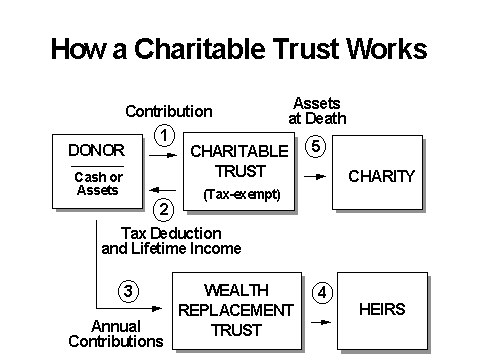
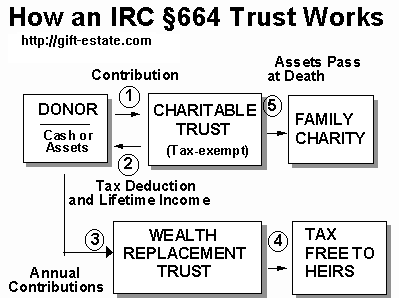
Charitable Remainder Trust  — This § 664 trust makes payments, either a fixed amount (annuity trust) or a percentage of trust principal (unitrust), to whomever the donor chooses to receive income. The donor may claim a charitable income tax deduction and may minimize any capital gains tax if the gift is of appreciated property.  At the end of the trust term, the charity receives whatever amount is left in the trust.  Charitable Remainder Uni-Trusts (CRUT – paying a fixed percentage) may provide some flexibility in the distribution of income, and thus can be helpful in retirement planning, while Charitable Remainder Annuity Trusts (CRAT – paying a fixed dollar amount) are more rigid and restrictive.

Charitable Lead Trust –This trust makes payments, either a fixed amount (annuity trust) or a percentage of trust principal (unitrust), to charity during its term. At the end of the trust term, the principal can either go back to the donor or to heirs named by the donor. The donor may claim a charitable tax deduction for making a lead trust gift.  However, a non-grantor lead trust does not usually generate a tax deduction, but it does eliminate the asset (or part of the asset’s value) from the donor’s estate.

Charitable Gift Annuity — A gift annuity is a contract between a charity and donor. In return for a donation of cash or other assets, the charity agrees to pay the donor, (or a friend or family member if the donor so chooses), a fixed payment for life. The donor can also claim a charitable tax deduction. If a donor funds a gift annuity with long-term capital gain property like appreciated stock, the donor will report only some of the gain, and may be able to report it in installments over many years.  Income from a gift annuity may be deferred for a period of years and these are often set up by younger donors to supplement retirement income.

Pooled Income Fund — The name describes this planned gift as a charity accepts gifts from many donors into a common fund and distributes the income of the fund to each donor or recipient of the donor’s choosing.  Income recipients receive income in proportion to their share of the fund.  A gift to a pooled fund provides a charitable income tax deduction and the donor will not have to pay capital gains tax if the gift is of appreciated property.  When an income beneficiary dies, the charity receives the donor’s portion of the fund.

Retained Life Estate — A donor may make a gift of a farm or residence to charity and retain the right to live in the house for the remainder of the donor’s life. The donor receives an immediate income tax deduction for the gift. At the donor’s death, the property goes to charity.

image While many of these split interest gifts and techniques are used for donors with estate tax liabilities, they still work when the donor has a modest estate.  A good advisor should be able to suggest tools to help a donor preserve personal financial security and still fulfill any charitable goals.

CONTACT US FOR A FREE PRELIMINARY CASE STUDY FOR YOUR OWN CRT SCENARIO

Subscribe to Henry & Associates’

Gift and Estate Planning Discussions

Want to be kept up to date

on CRT planning issues?

Join our mailing list!

Check our Trust and Planning Archive Hosted by Henry & Associates at Yahoogroups
Categories
New Articles

3 bedroom residence for sale – Springfield, Illinois

3 bedroom residence for sale – Springfield, Illinois

3 bedroom ranch style house for sale

22 Hyde Park – Springfield, Illinois

house

  • lots of mature trees, shaded lot (84 x 125) with completely fenced backyard and deck
  • backyardbackyard2
  • 1,680 square feet main floor, single level easy maintenance home
  • 2 car garage with garage door opener, storage space
  • family room – 11’9″ x 20’* with fireplace and built-in bookcases
  • familyroomfamilyroom2
  • kitchen – 11′ x 14’3″ with electric stove, microwave, range hood, disposal, dishwasher
  • dining room – 12′ x 11’6″
  • living room – 12′ x 18′
  • 3 bedrooms (10’9″ x 10’9″, 14’6″ x 11’9″, 15’6″ x 11’9″), master bedroom has walk-in (5′ x 6′) closet
  • 1 3/4 bathrooms
  • dry concrete basement has lots of storage, 2 sump pumps and extra waterproofing applied to foundation, utility area, hot water heater and furnace
  • wood deck accessed from family room
  • ceiling fans throughout house
  • central air conditioning
  • all electric utilities (cheapest CWLP rates in Illinois), Springfield is acknowledged as one of least expensive Illinois cities for living expenses
  • well maintained, recently installed new roof and gutters
  • numerous paved walking areas throughout neighborhood
  • This is a great neighborhood for families, offering popular schools, recreation and safety. There is a well maintained and supervised neighborhood swimming pool with lifeguard, tennis courts, playground with immediate access from backyard’s common area
  • Nearby Village of Chatham school bus picks up students at corner for the elementary, middle and high schools in the Chatham school district, other students may access private or parochial and Springfield educational services via city bus.
  • Springfield mass transit city bus service at corner, information on Springfield services and merchants and information on the city are available through the State Journal-Register Newspaper
  • nearby hospital, fire department, university campus (UIS) and community college (LLCC), conveniently located for for easy access to many Abraham Lincoln tourist sites
  • SIU Medical School’s introduction to the area, Springfield shopping, and  area businesses and sites of interest, and Sangamon county government services
  • Springfield’s Capital Airport offers commuter flights and general aviation transportation services and an annual air show.
  • Interstate I-55 exit #90 at Toronto Road is less than a mile away, offering an easy commute into Illinois’ growing capital city city

Interested buyers only – $121,300

Click for Springfield, Illinois Forecast

(* dimensions are not precise)

Categories
Case Studies and Articles

Charitable Trust Planning – Vaughn Henry & Associates

Charitable Trust Planning – Vaughn Henry & Associates

finance

Charitable Trust & Estate Planning

sectionbreak

Planning LinksOur OfficeProfessional Resources

Individuals considering a charitable remainder or lead trust need to understand that their financial goals can be met without interfering with their family’s security. Heirs can be protected and families united as they redirect their social capital. Develop your potential for economic citizenship.

Want to be kept up to date on CRT planning issues?

Join our moderated mailing list!
Enter your email address below, then click the ‘Join List’ button:

Powered by ListBot View List Archive

image
LE FastCounter

www.megalaw.com

“This site contains links to other Internet sites. These links are not endorsements of any products or services in such sites, and no information in such site has been endorsed or approved by this site.”
horseClick Here to Search the Web with PowerSearch.com!

Google

CONTACT US FOR A FREE PRELIMINARY CASE STUDY FOR YOUR OWN CRT SCENARIO

image

Categories
Case Studies and Articles

Advanced Estate and Charitable Trust Planning – Vaughn Henry & Associates, Springfield, Illinois

Case studies, workshops and professional planned giving resources.

Individuals considering a charitable remainder or lead trust need to understand that their financial goals can be met without interfering with their family’s security. Heirs can be protected and families united as they redirect their social capital. Develop your potential for economic citizenship.

  • Minimize Estate and Capital Gains Taxes, Reduce Income Taxes
  • Use a charitable remainder trust (CRT) as a Discretionary Pension Plan
  • Control Retirement Income with a NIMCRUT or Spigot Trust
  • Real Estate, Stock Portfolios, Business Assets Repositioned Tax-Free (Lifetime Control of More Capital) through a CRUT
  • Business Exit Strategies for Family Business Owners
  • Coordinate the Control of Your Social Capital with a CRT and Family Foundation or Donor Advised Funds by Giving Away the IRS’ Money.
  • Families with Donative Intent Can Meet Their Financial Goals Within an Integrated Financial and Estate Plan
  • Professional Development for NPO Gift Planners and Commercial Advisors
  • Host Workshops and Private Seminars for Not-for-Profits and Family Groups

Professional Resources and BooksnewNow booking workshops, briefings and seminars for 2006 and 2007 … Association of Advisors in Philanthropy – Conference Philanthropy … Public Link to PGDC – CRT Advisors’ Liability and … New estate and gift tax rates in place now, but what effect will sunset have?

PhilanthroCalc for the WebCONTACT US FOR A FREE PRELIMINARY CASE STUDYFOR YOUR OWN CRT SCENARIO or try your own at Donor Direct

Please note — there’s much more to estate and charitable planning than simply running software calculations, but this service does give you a chance to see how the calculations affect some of the design considerations.

This is not “do it yourself brain surgery”.

When might a CRUT be superior to a CRAT? Which type of CRT is best used with which assets? Although it may be counter-intuitive, sometimes a lower payout CRUT makes more sense and pays more total income to beneficiaries. Learn why and when to use a CLUT vs. CLAT and the traps in each lead trust. Which tools work best in which planning scenarios? Check with our office for solutions to this alphabet soup of planned giving tools.

image

Categories
Support

Henry & Associates – Gift and Estate Planning Services

Henry & Associates – Gift and Estate Planning Services

house for sale info

Henry & Associates

Gift and Estate Planning Services

Springfield, Illinois

Enter

Advanced Estate and Gift Planning Tools to Control Family Wealth.

Professional links and resources to disinherit the IRS and conserve social capital.

Eliminate estate and unnecessary income taxes, preserve family businesses and maximize family philanthropy.