Categories
Author: Gabriel
Categories
x
Categories
x
Will Your Family Business Survive to the Next Generation?
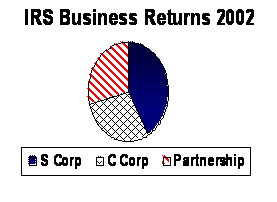 The wealth of theUnited Statesis often concentrated in family businesses, not the stock market, despite the occasional dire media warnings on slow news days. The IRS now reports that there are nearly a million more S corporation (more often used in smaller businesses) tax returns filed than regular corporate returns, and the gap continues to widen annually. Factor in the partnerships and sole proprietorships, and you find numerous entrepreneurs cranking out products and services that keep the economy rolling along. Unfortunately, few closely held or family businesses have done any succession or disaster planning. Vernon Rudolph, founder of the well-known Krispy Kreme doughnut franchise, died in 1973, but had no estate plan for his family. As a result, Krispy Kreme had to be sold and Beatrice Foods eventually acquired the company in 1976, and its family influence was lost. Even though Rudolph established his business inWinston-Salemin 1937, far from the stresses of big city concerns, he failed to create a plan that would preserve and protect his business interests for his family.
Why Do Family Businesses Fail?
Despite the posturing by politicians advocating tax relief and the elimination of the death tax, the reality is that by changing the rules and moving the goal posts so frequently, Congress has created a tax environment that results in taxpayer paralysis Estate planning should be a thoughtful process designed to work over many years, but a sense of impermanence and capriciousness in tax laws fosters inaction. While business owners acknowledge the risks of neglecting their transition problems, they doom their business to failure because they will not take the necessary steps to minimize the easiest tax to avoid with just a little planning. Even if there is no federal estate tax concern, there will still be taxes on income and capital gains, and newly imposed state inheritance taxes to deal with. However, the tax tail must not wag the dog. Once the tax issues are addressed, it may be more important to find a way to pass down a value system and maintain continuity. These are critical steps in the planning process, but too many advisors are not helping matters by ignoring the non-tax conflicts in their hurry to complete an estate plan and push their clients out the door with cookie cutter plans.
The estate planning process can be confusing and highly technical, contributing to the 66% of family business that fail to make it to the second generation. Try to pass the business on to the third generation and fewer than 14% make the grade. (Keeping the Family Business Healthy, John L. Ward, 1987). Among many of the other reasons for such high failure rates is the founder’s syndrome, or the inability to let go. For some owners with unhappy marriages, they have taken refuge in the business, while other owners dislike dealing with personally traumatic issues like mortality or disability. All of this contributes to a revolving door of quasi-retirement for the founder who has little else in life other than work, and who keeps showing up at the office without relinquishing control of the reins.
Many of the founders business interests are closely intertwined with their driven personalities. This determination to succeed is the foundation for their many achievements, and the source of future conflicts. Since control concerns are such a major part of their lifes work, acknowledging any loss of mental acuity or mortality is a real struggle. Additionally, many founders have made some bad decisions along the way and they worry about disrupting family relationships in the process of getting the situation back under control. How so? They may have ignored some family members by favoring just a few select heirs, or minimized the advice from non-family key employees. Too often, business founders put heirs on the payroll with no-show jobs or with limited responsibilities. By setting family members up in executive roles for which they have little training or aptitude, the founder creates unrealistic expectations for heirs. Add to the mix an heir who really works in the business and there will often be a festering sense of inequity where one heir is working and the other heirs are not; yet all draw a paycheck.
In the classic estate planning process, owners pass value down to heirs in the form of stock in corporations or partnership units in family entities. The problem is that owners will not voluntarily give up control of a business in which they have invested a good part of their lives, and such workaholics will not accept the concept of a life in retirement or the need for a family forum in which a fair and open exchange of information is necessary. For retirement to succeed, the energies and priorities of the founder have to be channeled into something other than work, but that is very hard when the founder fears becoming irrelevant and unappreciated by succeeding heirs.
Since the principals constantly interact with each other outside the business, family entities are often in turmoil because problems are brought home and the management stresses are not easily set aside. When children marry and have families of their own, the in-laws and third generation all want input. Getting all the players to focus on problems and achieve a unified management system is a lot like herding cats, not an easy situation under the best of circumstances. Besides conflicting goals, intergenerational conflict, and sibling rivalry, tension in the office is a foregone conclusion. Add to that volatile mix a history of poor communication and a failure to enact meaningful changes in management and frustration will build. Thus, it should be no surprise that few businesses maintain operations far beyond the founders life. In addition, it should shock no one that the founder may be the worst teacher for heirs as he tries to integrate them into the family businesshe has spent his life fixated on control, not on sharing information or techniques. Sometimes a non-family key employee or mentor can be a buffer and may be a better choice to interface between the generations to make sure everyone is prepared to assume his or her rightful place in the business.
Not all is lost. Some families manage to make the business work down through the years. The best example in theU.S.is the Zildjian Cymbal Co. of Norwell,Massachusetts Founded in 1623 by an alchemist named Avedis I in Constantinople, and relocated to the Quincy, MA in 1929, this family business holds the U.S. record for continuity. The founder discovered a metal alloy that created cymbals possessing special clarity. The business continues 14 generations later under the direction of two of his female heirs, Craigie and Debbie, after almost 400 years of continuous operation focused on supplying their niche product to musicians around the world.
The Plan
Generally, for a succession plan to work, the main concerns about death, disability and retirement must be addressed early and often. In the post 9/11 world, it would be terribly imprudent to ignore the potential for catastrophic loss of principal family members. Therefore, create a plan that addresses these questions:
- How can institutional memory be enhanced and senior family members achieve a sense of validation.
- Who is going to own the business, and in what format?
- What steps must be taken to ensure continuity, and which advisors need to be brought into the transition team to make sure it happens?
- Who is going to operate the business, make day-to-day decisions, pay bills, sign checks?
- Has the business buy-sell agreement been updated, and are realistic valuation techniques in place?
- Will there be adequate liquidity to continue to operate the business when the founder steps out of the picture and still provide for an equitable distribution of ownership interests?
- Will non-operating heirs be satisfied with reinvesting the profits back into the business to expand? If not, managers face a shortsighted process of carving out value for income. Or will heirs take the first good offer for the business and head to warm and gentle climates?
- Can the operating heirs buy out the others in a fair exchange of value for control?
- Can all of this planning be done in a tax efficient manner without disrupting the business?
- If there is a family heir anointed as successor, does this person have a grasp on the business operation, its employees, suppliers, credit worthiness, and customers?
- Do the heirs have the capacity and training to make decisions and keep the company moving forward with the full confidence of the other family members? Alternatively, is there a key employee or outside manager available to hold the business together?
Most companies fail within a short time of their inception. Family owned business have a tradition of being more durable, but it takes special care and a lot of extra effort to overcome these hurdles and succeed for the next generation. Start the process early and preserve a lifetime of family work for the future.
Nothing happens around here until someone sells something
Malpractice Issues XV
Nothing happens around here until someone sells something.
Unfortunately, there are still financial services companies pitching charitable trusts like loaves of bread, commodities sold to consumers who depend on their advisors for objective financial advice. Until advisors move from a commodity selling mentality to a values based, client-oriented consulting practice where all of the financial and estate planning tools are used in an integrated process, they run the chance of offering limited choices and potential harm to their clients. Add to that mixture the competing multi-disciplinary planning team approach pushed by law and accounting firms offering financial products and services, the traditional insurance and brokerage community may soon be on the outside looking in. While there is nothing wrong with an insurance agent selling a risk management product like an insurance policy or deferred annuity, not all estate planning clients need those products. This necessitates a change in business practices, because avoiding clients with a desire to establish a charitable estate plan simply because neither a life insurance policy nor annuity sale will occur is extremely short sighted. Worse yet, brokers border on the unethical when they steer clients away from advisors who can implement other necessary aspects of a plan simply because they will not generate commissionable sales.
What avoidable problems are charitable trust planners experiencing today? Too many disgruntled trust creators were lead to believe their trust investments would continue to outperform the market. With the prolonged bear market in recent years, trust makers have learned that CRUT income beneficiaries may actually receive declining payments instead of optimistically forecast increasing payouts. Too high payouts that eroded the value of the trusts principal and with less money at work, the trust may not recover enough financial strength to be useful over the income beneficiarys life expectancy. While the 10% remainder rule introduced in 1997 precluded a life payout CRT for young donors, historically low §7520 rates may further derail many annuity trusts (CRAT) and gift annuities (CGA). These and many other errors created by over-enthusiastic product sellers have cast an unappealing light on legitimate charitable planning, which otherwise offers truly motivated clients a great opportunity to create tax efficient philanthropy.
 Many advisors have been to marketing seminars and were issued financial hammers, and everything begins to look like nails. Unfortunately, quite a few insurance and mutual fund companies consistently promote the CRT, not for its philanthropic purposes, but to sell wealth replacement life insurance and as a way to take illiquid assets and swap them for proprietary investments. With the recent bear market, many of these product-oriented charitable trust sales have come back to haunt their promoters when they turned out to be short-term solutions to a marketing problem and created a lot of unhappy clients in the meantime.
In pitching the advantages of a CRT, many advisors stress capital gains avoidance. In reality, it is only capital gains deferral, and that depends as much on the replacement investments held by the CRT as to those that were initially placed in trust. Unfortunately, tax efficiency inside a CRT is not widely understood or even appreciated as an important factor of client satisfaction. Improperly managed, the CRT becomes an ordinary income pump instead of a more tax efficient means to distribute realized capital gains in an orderly way. If clients are not under some pressure to liquidate an entire portfolio of appreciated assets via the CRT, maybe they would be better off selling a few shares every year for income, and paying the temporarily reduced tax on those annual conversions. Thanks to JGTRRA 2003, capital gains tax liabilities make number crunching even more important since the lower 15% capital gain rate coupled with the new 15% dividend rate has changed the dynamics. If the client is primarily motivated to save tax, and not motivated by altruism, then why bother with a CRT? Advisors who remain focused on the clients needs will stay out of trouble and will gain more referrals from happy clients in the future


 CONTACT US FOR A FREE PRELIMINARY CASE STUDY FOR YOUR OWN CRT SCENARIO or try your own at Donor Direct. Please note — there’s much more to estate and charitable planning than simply running software calculations, but it does give you a chance to see how the calculations affect some of the design considerations. This is not “do it yourself brain surgery”. When is a CRUT superior to a CRAT? Which type of CRT is best used with which assets? Although it may be counter-intuitive, sometimes a lower payout CRUT makes more sense and pays more total income to beneficiaries. Why? When to use a CLUT vs. CLAT and the traps in each lead trust. Which tools work best in which planning scenarios? Check with our office for solutions to this alphabet soup of planned giving tools.
Nothing happens around here until someone sells something
Malpractice Issues XV
Nothing happens around here until someone sells something.
Unfortunately, there are still financial services companies pitching charitable trusts like loaves of bread, commodities sold to consumers who depend on their advisors for objective financial advice. Until advisors move from a commodity selling mentality to a values based, client-oriented consulting practice where all of the financial and estate planning tools are used in an integrated process, they run the chance of offering limited choices and potential harm to their clients. Add to that mixture the competing multi-disciplinary planning team approach pushed by law and accounting firms offering financial products and services, the traditional insurance and brokerage community may soon be on the outside looking in. While there is nothing wrong with an insurance agent selling a risk management product like an insurance policy or deferred annuity, not all estate planning clients need those products. This necessitates a change in business practices, because avoiding clients with a desire to establish a charitable estate plan simply because neither a life insurance policy nor annuity sale will occur is extremely short sighted. Worse yet, brokers border on the unethical when they steer clients away from advisors who can implement other necessary aspects of a plan simply because they will not generate commissionable sales.
What avoidable problems are charitable trust planners experiencing today? Too many disgruntled trust creators were lead to believe their trust investments would continue to outperform the market. With the prolonged bear market in recent years, trust makers have learned that CRUT income beneficiaries may actually receive declining payments instead of optimistically forecast increasing payouts. Too high payouts that eroded the value of the trusts principal and with less money at work, the trust may not recover enough financial strength to be useful over the income beneficiarys life expectancy. While the 10% remainder rule introduced in 1997 precluded a life payout CRT for young donors, historically low §7520 rates may further derail many annuity trusts (CRAT) and gift annuities (CGA). These and many other errors created by over-enthusiastic product sellers have cast an unappealing light on legitimate charitable planning, which otherwise offers truly motivated clients a great opportunity to create tax efficient philanthropy.
 Many advisors have been to marketing seminars and were issued financial hammers, and everything begins to look like nails. Unfortunately, quite a few insurance and mutual fund companies consistently promote the CRT, not for its philanthropic purposes, but to sell wealth replacement life insurance and as a way to take illiquid assets and swap them for proprietary investments. With the recent bear market, many of these product-oriented charitable trust sales have come back to haunt their promoters when they turned out to be short-term solutions to a marketing problem and created a lot of unhappy clients in the meantime.
In pitching the advantages of a CRT, many advisors stress capital gains avoidance. In reality, it is only capital gains deferral, and that depends as much on the replacement investments held by the CRT as to those that were initially placed in trust. Unfortunately, tax efficiency inside a CRT is not widely understood or even appreciated as an important factor of client satisfaction. Improperly managed, the CRT becomes an ordinary income pump instead of a more tax efficient means to distribute realized capital gains in an orderly way. If clients are not under some pressure to liquidate an entire portfolio of appreciated assets via the CRT, maybe they would be better off selling a few shares every year for income, and paying the temporarily reduced tax on those annual conversions. Thanks to JGTRRA 2003, capital gains tax liabilities make number crunching even more important since the lower 15% capital gain rate coupled with the new 15% dividend rate has changed the dynamics. If the client is primarily motivated to save tax, and not motivated by altruism, then why bother with a CRT? Advisors who remain focused on the clients needs will stay out of trouble and will gain more referrals from happy clients in the future
©2003 — Vaughn W. Henry


Vaughn W. Henry
 CONTACT US FOR A FREE PRELIMINARY CASE STUDY FOR YOUR OWN CRT SCENARIO or try your own at Donor Direct. Please note — there’s much more to estate and charitable planning than simply running software calculations, but it does give you a chance to see how the calculations affect some of the design considerations. This is not “do it yourself brain surgery”. When is a CRUT superior to a CRAT? Which type of CRT is best used with which assets? Although it may be counter-intuitive, sometimes a lower payout CRUT makes more sense and pays more total income to beneficiaries. Why? When to use a CLUT vs. CLAT and the traps in each lead trust. Which tools work best in which planning scenarios? Check with our office for solutions to this alphabet soup of planned giving tools.
Many of the charitable remainder trusts created during the high-flying 1990’s, especially those created prior to the imposition of the 10% remainder rule, have cratered along with the market decline. For those with net income type trusts, the inability to find suitable income investments means that most of those trusts are now seriously underperforming. What options exist for trustees and income beneficiaries with their trusts? Depending on state law, the controlling language of the trust document, and the trustmaker’s charitable inclinations, there may be a few options.
1. Some charitable remainder trusts are created with a charitable organization as one of the income beneficiaries. In this unusual case, this option to share the wealth exists as long as there is at least one tax paying entity receiving an income interest too.
2. For the trustee who no longer wants to deal with the hassle of a charitable trust, it may be possible to assign the income interest to charity, or terminate the trust entirely and accelerate the trust principal to charity now. This gift generates another income tax deduction based on the present value of the income interests given away. However, there may be state specific laws or spendthrift language in the trust document that would prevent the assignment of the beneficiaries’ income interest.
3. Make principal distributions from the charitable trust. While there is no additional charitable income tax deduction, for the charitable client who wants to tap assets for current gifts, this may work if the document allows its use. Otherwise, a letter ruling from the IRS may be necessary.
 4. Seek court ordered termination of the trust and split the CRT into two portions, an actuarially calculated interest passing to the income beneficiary, and the remainder interest passing to charity. There is no added income tax deduction, and the income beneficiary receives a zero basis capital asset to reinvest and use as needed.
For example, Garth Books, 65 years old, created a NIMCRUT several years ago, but with declining bond rates, his trust produces less income than anticipated. However, the stocks inside the trust have appreciated, so Garth finds himself with a more valuable trust, but is unable to distribute enough income. His 8.5% income interest would not be prudent in todays environment, but he selected the higher payout anticipating continued double-digit interest rates. By cashing out the trust, Garth can reinvest the proceeds and use them to maintain his lifestyle.
5. Carrying the “split the blanket” philosophy one-step further, Private Letter Ruling 200152018 offers some insight into the IRS mindset about the sale of a CRT income interest in exchange for a more stable income through a charitable gift annuity. While splitting the two interests will not generate a tax deduction, the subsequent exchange of a gift annuity for the income interest will generate a deduction, as would the purchase of any CGA. The problem with basing any planning decisions on a private letter ruling is that it was issued to one taxpayer based on a specific fact pattern, and the IRS is under no obligation to act consistently. You cannot rely on it as a precedent. If you are contemplating doing something similar, seek your own letter ruling and be safe.
Charitable remainder trusts are irrevocable, but with suitable language tremendous flexibility in design and management is possible, and this is one significant reason to use a custom drafted document rather than an IRS prototype. Consider the advantages of setting up the trust properly:
§ Donor and/or Trustmaker may serve as trustee for the CRT
§ Modify trustee or use a special independent trustee
§ Revoke or modify charitable remainder interests
§ Use revocable, multiple, or non-spousal income interests
§ Distribute of principal to charity before the trust terminates
§ Use multiple charitable remainder interests
§ Define income for fiduciary accounting purposes
§ Accept closely-held or illiquid assets
§ Accept testamentary contributions
§ Distribute assets in kind
§ Unbundle the trustee, investment, and administrative functions
§ Modify investment objectives to improve tax efficiency
Seminar selling is a great marketing tool; its something designed to answer questions, present the speaker as a problem solver, motivate prospects, and generate referrals. In this particular case, an elderly couple attended a seminar at the local senior center. The seminar, co-hosted by a charity and three insurance agents, pushed charitable remainder trusts (CRT) by stressing how real estate makes for a problematic inheritance (e.g., estate and/or capital gains tax, liquidity, management concerns, etc.) In rapidly growing states like California, every senior attending that seminar had a substantial percentage of their net worth in real estate.
 Speaker #1 met with elderly clients later and told them a CRT was the perfect tool for them. Although their estate was valued at $1,200,000 and taxes shouldnt have been an issue, he scared them with tales of high estate taxes and lack of liquidity. They agreed to do a CRT benefiting the co-sponsoring charity and the charitys development officer met with them. Speaker #1 sold life insurance to fund a Wealth Replacement Trust or Irrevocable Life Insurance Trust (ILIT). Speakers #2 and #3 handled the reinvestment of the real estate sales proceeds. Speaker #3 is married to the charitys representative, but this isnt disclosed.
Speaker #1 brought in his attorney, arranged for insurance coverage, and while insurance is often useful, these clients are high-risk and uninsurable, resulting in a $40,000 premium instead of the projected $10,000. Further complicating the planning, the rental properties used to fund the CRT had mortgages, and debt encumbered charitable trusts are tax bombs waiting to explode. To save the sale, Speaker #2 (also a mortgage broker) arranges to transfer the rental property mortgages to the family home. The charitys representative also tries to save the sale by telling clients that they can increase the CRT payout rate by replacing the relevant page of the already signed and irrevocable document. Speaker #1 continues to try to save the sale by implying that premiums will be much lower in years after the second year (he misrepresented that fact). Speaker #3 also tried to save the sale by telling the clients that their CRT will simply repay the new mortgage on their home in full, once the trust was finalized
 The attorney didnt draft the ILIT until the insurance policy has been in force for over a month. No one bothered to tell the clients that they needed a qualified appraisal on the transferred properties, so no income tax deduction was available, but that was not a major issue since the clients had almost no income, so the deduction wouldn’t have helped much anyway. The speakers told clients repeatedly that the income from the CRT would cover the insurance premiums, so clients were writing checks from the charitable trust accounts directly to the insurance company. Over the next two years, no one did any trust accounting or advised the clients that trust accounting would be required. Speakers #2 and #3 invested the CRT assets into a deferred annuity earning 6%, even though the CRT payout rate was set at 10%, producing a declining income stream. When all the dust settled, the clients had only $200,000 left outside of the CRT, an unaffordable and collapsing insurance policy, a decreasing annual income, and a staggering bill for the accounting work needed to re-file past years tax returns and pay penalties and interest.
What were the motivations for all of these shenanigans? Speaker #1 earned a $30,000 commission. Speaker #2 earned $4,500 in mortgage broker fees, speakers #2 & #3 earned $12,000 in annuity commissions, and the charitys representative (married to Speaker #2) earned a percentage-based bonus for bringing in the gift. Too bad, there should have been some consideration for the client/donor and there wouldnt have been litigation generated. If you aim for immediate gratification, youre likely to do great harm with your toxic planning to all involved.



Vaughn W. Henry
 CONTACT US FOR A FREE PRELIMINARY CASE STUDY FOR YOUR OWN CRT SCENARIO or try your own at Donor Direct Please note — there’s much more to estate and charitable planning than simply running software calculations, but it does give you a chance to see how the calculations affect some of the design considerations. This is not “do it yourself brain surgery”. When is a CRUT superior to a CRAT? Which type of CRT is best used with which assets? Although it may be counter-intuitive, sometimes a lower payout CRUT makes more sense and pays more total income to beneficiaries. Why? When to use a CLUT vs. CLAT and the traps in each lead trust. Which tools work best in which planning scenarios? Check with our office for solutions to this alphabet soup of planned giving tools.
The Applicable Federal Rate (AFR) What Works in a Changing Environment?
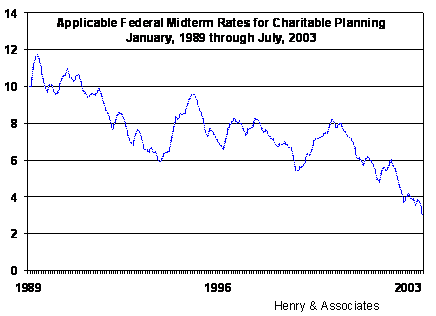
In 1988, TAMRA created a means to measure the time value of money for gift and estate planning functions. Prior to 1971, the government used 3.5% as an assumed rate, but changed to a rate that floats with debt instruments, and this rate changes monthly. Essentially, the IRS tries to determine what a stream of income or a deferred gift is worth and adjusts the value over time. For lifetime gifts, periodically updated mortality tables provide a mechanism for estimating the time portion of the time value, but whats needed in a present value/future value calculation is a way to assign a market interest rate. As a result, §7520 requires that the applicable rate be based on federal securities with maturities between three and nine years. Most estate and gift calculations use the interest rate in the month of the transfer, but for charitable gifts, there is an exception for donors who may elect to use either the current months rate or one from the previous two months. The most recent* §7520 charitable midterm rate (120%) used in charitable planning calculations is the lowest rate seen in years, and may create serious problems for donors contemplating a CRAT or CGA. Because some charitable gifts produce a remainder value for donors or heirs, and others produce an income value, the changing rates provide a seesaw effect; as the rates go up, some transfers are more attractive and others less so.

What tools and tactics work better when Section 7520 rates are down?
Private Annuities, Grantor Retained Annuity Trusts (GRAT), Charitable Lead Annuity Trusts (CLAT), and Charitable Gifts of a Remainder Interest in a farm or residence. Self Canceling Installment Notes (SCIN),Saleto an Intentionally Defective Irrevocable Trust (IDIT), and Dynasty Trusts pass more assets or reduce taxable transfers to remainder beneficiaries.
What tactics are more restricted when Section 7520 rates are depressed?
Grantor Retained Income Trusts (GRIT), Personal Residence Trusts and Qualified Personal Residence Trusts (PRT, QPRT), Charitable Remainder Annuity Trusts (CRAT may fail either the 10% remainder test or the Rev. Rul. 77-374 exhaustion test), Charitable Gift Annuities (CGA although the deduction goes down, the amount of principal attributed in the annuity payments goes up, if the annuity does not pass the 90% test, the charity offering the CGA may have a UBTI problem), Life Estates.
Which tools are generally unaffected by AFR changes?
Grantor Retained Unitrusts (GRUT), Charitable Remainder Unitrusts (CRUT), Charitable Lead Unitrusts (CLUT)
* Revenue Ruling 2003-71 indicates the July rate is 3.0%. Rates for June and May were 3.6% and 3.8%, respectively.
|
CMFR |
Jan |
Feb |
Mar |
Apr |
May |
Jun |
Jul |
Aug |
Sep |
Oct |
Nov |
Dec |
|
10.00 |
10.00 |
11.22 |
11.58 |
11.68 |
11.26 |
10.54 |
10.01 |
9.68 |
10.10 |
10.07 |
9.70 | |
|
1990 |
9.57 |
9.70 |
10.27 |
10.54 |
10.61 |
10.97 |
10.53 |
10.44 |
10.28 |
10.63 |
10.59 |
10.25 |
|
1991 |
9.78 |
9.64 |
9.41 |
9.50 |
9.62 |
9.53 |
9.66 |
9.87 |
9.59 |
9.08 |
8.69 |
8.51 |
|
1992 |
8.10 |
7.64 |
8.06 |
8.43 |
8.56 |
8.47 |
8.25 |
7.82 |
7.19 |
6.96 |
6.83 |
7.40 |
|
1993 |
7.63 |
7.50 |
7.08 |
6.56 |
6.57 |
6.41 |
6.67 |
6.40 |
6.44 |
6.02 |
5.91 |
6.10 |
|
1994 |
6.40 |
6.42 |
6.45 |
7.08 |
7.74 |
8.33 |
8.22 |
8.49 |
8.49 |
8.56 |
8.97 |
9.33 |
|
1995 |
9.54 |
9.59 |
9.34 |
8.84 |
8.58 |
8.22 |
7.56 |
7.27 |
7.68 |
7.59 |
7.35 |
7.12 |
|
1996 |
6.89 |
6.75 |
6.56 |
7.08 |
7.65 |
7.93 |
8.12 |
8.24 |
7.99 |
8.09 |
7.94 |
7.59 |
|
1997 |
7.34 |
7.68 |
7.72 |
7.82 |
8.25 |
8.19 |
8.00 |
7.69 |
7.51 |
7.63 |
7.34 |
7.25 |
|
1998 |
7.13 |
6.84 |
6.72 |
6.85 |
6.84 |
6.95 |
6.83 |
6.70 |
6.67 |
6.16 |
5.42 |
5.43 |
|
1999 |
5.59 |
5.67 |
5.80 |
6.35 |
6.28 |
6.46 |
7.01 |
7.16 |
7.19 |
7.25 |
7.32 |
7.46 |
|
2000 |
7.47 |
7.90 |
8.19 |
8.08 |
7.70 |
7.96 |
7.96 |
7.62 |
7.50 |
7.33 |
7.23 |
7.07 |
|
2001 |
6.75 |
6.10 |
6.10 |
5.95 |
5.73 |
6.04 |
6.16 |
6.01 |
5.79 |
5.52 |
4.97 |
4.78 |
|
2002 |
5.40 |
5.58 |
5.43 |
5.60 |
6.01 |
5.71 |
5.53 |
5.10 |
4.51 |
4.16 |
3.68 |
3.98 |
|
2003 |
4.12 |
3.93 |
3.89 |
3.56 |
3.82 |
3.68 |
3.06 |
|
|
|
|
|



Vaughn W. Henry
 CONTACT US FOR A FREE PRELIMINARY CASE STUDY FOR YOUR OWN CRT SCENARIO or try your own at Donor Direct Please note — there’s much more to estate and charitable planning than simply running software calculations, but it does give you a chance to see how the calculations affect some of the design considerations. This is not “do it yourself brain surgery”. When is a CRUT superior to a CRAT? Which type of CRT is best used with which assets? Although it may be counter-intuitive, sometimes a lower payout CRUT makes more sense and pays more total income to beneficiaries. Why? When to use a CLUT vs. CLAT and the traps in each lead trust. Which tools work best in which planning scenarios? Check with our office for solutions to this alphabet soup of planned giving tools.
Billie and George Huntley have had a longstanding and supportive relationship with their church. Both serve on various boards, and Mrs. Huntley recently joined the churchs new fundraising and endowment committee. Billies background in life insurance has given her a good understanding of the financial importance of long-term retirement planning, and she introduced some of the congregation to the idea of charitable gift annuities (CGA). The reason Billie knew something about gift annuities is that she had recently attended a program where life insurance producers were encouraged to sell these annuities to their clients and reap handsome commissions for their efforts.
Gift Annuities are Excellent Charitable Tools
In an effort to protect charities from registration and oversight by the SEC, the Philanthropy Protection Act of 1995 (PPA/HR 2519) stipulated that a CGA is to be treated as a charitable gift, not as a regulated security. Further insulating the charity from registering as an investment company, the PPA also prohibited the payment of a commission in the sale of a gift annuity. Recently, the National Association of Securities Dealers (NASD) issued a statement that called on registered representatives to avoid offering any gift annuity by labeling it an unregistered product.* Additionally, the National Committee on Planned Giving (NCPG) and the American Council on Gift Annuities (ACGA) have both gone on record to denounce the sale of gift annuities and the payment of commissions by any charities implementing them.
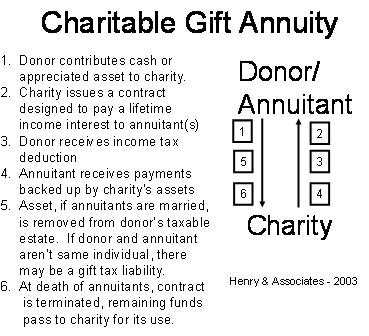
The gift annuity is generally a creature of state law, essentially acting as a bargain sale agreement between a charity and the donor. Since gift annuities closely resemble insurance company single premium immediate annuities (SPIA), states generally have insurance departments oversee or regulate the contracts. The payments from both the CGA and SPIA are both reported to the IRS on a 1096, then the donor reports the income on a 1099-R. Unlike the SPIA, part of the gift annuity payment may be part capital gain (if funded with a contributed capital gain asset), part ordinary income, and part return of principal. The CGA also differs from the commissionable SPIA sold by insurance producers because, as a planned gift, it provides a charitable income tax deduction, and it is limited to providing only lifetime payments to just one or two annuitants. Unlike charitable remainder trusts, there is no need for the donor to pay for annual trust accounting, compliance, or document drafting services, and the gift annuity issuing charity is financially liable for the ongoing stream of payments.
Many seniors shop annuity rates, seeking a higher rate of return on their savings, and may be mislead by advertising claims when they overlook the charitable component of a CGA. Too often, an overenthusiastic marketer will compare a gift annuity to a banks certificate of deposit (CD) or to a commercial insurance companys SPIA. Unfortunately, it is not an apples and apples comparison. Medically underwritten commercial annuities offers more options beyond one and two life only guaranteed payments, and often pay a higher annuity payment. When promoters pitch a CGA as a product in a way that puts it in a comparative situation to regulated commercial products, they confuse donors. This is especially true when CGA rates are compared to bank CD rates.
Commercial Annuity vs. the Gift Annuity
Hypothetically, a $100,000 CGA for a 70-year-old would produce $6,700 annually (paid monthly) and a concurrent income tax deduction of $32,204, but a comparable one life SPIA for a 70-year-old man produces $9,060 annually. Obviously, one cannot make money by giving it away, but donors need to remember that a CGA is primarily a charitable gift, not a purchased money making tool. Since the premise behind a CGA is that there should be a 50% residual value after the annuity terminates, theres no way a charitable gift annuity can (or should) compete dollar for dollar as an investment tool; only when the philanthropic goals of the donor are factored in does it make financial sense.
In light of historically low fixed income interest rates and recent gift annuity defaults by insolvent charities, it makes sense for donors and their advisors to look carefully at the financial strength of any charity offering split-interest gifts before making an irrevocable transfer to a nonprofit organization. Prior to signing any gift annuity agreement, ensure disclosures required by state law are clear and all the parties to the transaction understand their responsibilities.
*NASD Regulatory & Compliance Alert, Regulatory Short Takes — Charitable Gift Annuities, Summer 2002.