Making a Plan to Deal with EGTRRA
 John and Dee Owens, both 65, have a family business that they expect to pass down to their son, John Jr., but they have other children to whom they plan to leave their stock portfolio and retirement accounts. Through a series of corporate transactions, John Jr. will receive the stock owned by his father at no gift or estate cost and in return, his parents will have income through a deferred compensation and salary continuation agreement. With their lifestyle and retirement security addressed, John and Dee turned their attention to their remaining assets to see how they could best pass them to their other three children who arent involved in the family businesses. In 2002, the Owens jointly held stock portfolio had a value of $5 million and Johns IRA was worth $1.5 million. Theyve decided to take only the minimum distributions, as required by law, to stretch out their retirement account. This lets them leave the stock portfolio untapped to let it continue to appreciate as it has for the last 16 years.
When the Owens sat down to discuss their planning needs with their tax, legal and planning advisors, they were stunned to see how the estate tax relief they believed would protect their estate really affected their planning. With Congress constantly tinkering with the estate tax by trying to raise the exempt amount, abolish the tax, or reintroduce the tax it has become increasingly difficult to plan when the goalposts keep moving. After EGTRRA 2001, everyone agreed to plan for what they knew today, keep their planning flexible and their options open. The result was an integration of several tactics and strategies designed to achieve a zero estate tax plan. With only two principal assets left to plan for, and a desire to control their social capital, the Owens proceeded as follows.
Their Stock Portfolio
Given the uncertainty about the long-term nature of tax reform and estate tax relief, John and Dee decided to act now, rather than hope for an unlikely repeal of the death tax. When the Owens saw how quickly their equity values would grow away from their ability to exempt those assets from tax, they created a family limited partnership to hold their stocks and some other investment assets. After the partnership started, the Owens made lifetime exemption gifts of limited partnership assets to the kids, and then agreed to sell the remaining partnership units to an intentionally defective irrevocable dynasty trust (IDIT) for the benefit of their three kids and grandchildren. By doing this installment sale, the Owens freeze the value, eliminate another appreciating asset from their estate and transfer the growth to their heirs. This leaves only the need to deal with the income in respect of a decedent (IRD) assets found in their IRA and note to clean up the loose ends. When their planning is finished, there should be no estate tax on their assets at death
Their IRA
By the time John and Dee factored in the required distributions commencing at age 70 and viewed how their remaining estate would appreciate to, and beyond, life expectancy, they concluded that the IRS was likely to harvest significant taxes from their estate. Even in 2010, when the federal estate tax disappears for one year, there was still an income tax liability projected with their IRA.
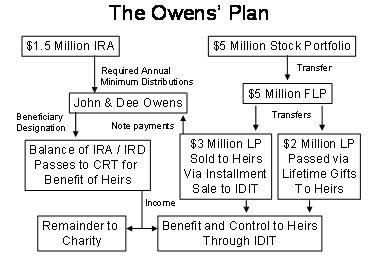 IRA planning has been in the news lately because of relaxed new distribution rules and, some say, easier choices about beneficiary designations. As a result, the common advice for many is to make use of a stretch IRA as a way to delay recognition of the deferred income for as long as possible. That may make sense for many families, but they must understand some quirky issues if the stretch option is used. Firstly, only a surviving spouse has the ability to roll over and start an IRA with new beneficiaries under his/her own life expectancy. Secondly, while the stretched IRA may protect heirs from immediate income tax liabilities, it is not sheltered from estate tax. This double dip by the tax collector may ultimately reduce the value of the inherited IRA by 70%. Thirdly, after going through all of the gyrations needed to stretch an IRA and protect it from tax, many younger beneficiaries disrupt the planning by simply cashing in the IRA and paying the tax. In their mind, it was free money and there wasnt any reason to wait to enjoy their inheritance. Fourthly, an IRA only produces ordinary income, taxed at higher rates than capital gains due from stock sales and lastly, the IRA cant step up in basis like the inherited stock portfolio.
After the Owens reach age 70, their qualified retirement account typically wont appreciate as quickly as the stock portfolio. Why? Even though invested just like their equity account, the required distributions nibble away at the IRAs growth. However, even with an account slowly eroded by mandatory payments, the IRA has the potential to be a significant asset and clients should know their options that include:
1. Preserve the IRA via minimum distributions for as long as possible and split it into multiple accounts. Then name each beneficiary to receive the proceeds over their life expectancies. Seek competent counsel in this area, as the rules change based on the IRA owners payout status.
2. Spend the IRA (qualified retirement plan asset) and dont pass anything to heirs. While this solves the estate and inherited income tax problem, there is a timing issue (running out of money before running out of time) involved unless the account is annuitized.
3. Take withdrawals from the IRA and buy life insurance to replace the value of assets transferred to charity. Whether this option is economical depends on the clients age, health, tax status, and timing of death. Success also depends on the insurance ownership being outside the estate to avoid unnecessary taxes on the proceeds.
4. Take taxable withdrawals from the IRA and set up a concurrent charitable remainder trust with the appreciated equity portfolio. Use the tax deduction to offset the IRA tax liabilities and the extra cash flow to buy life insurance inside an irrevocable trust. Insurance proceeds structured in this fashion are generally income and estate tax free, and more net wealth may accrue to the heirs without concerns about a loss of step up in basis.
5. Name a charitable remainder trust (probably a CRUT rather than a CRAT) as the IRA beneficiary for the surviving spouse, or name children as income beneficiaries if all of the estate planning tax considerations have been addressed. Besides minimizing the immediate recognition of ordinary income, it provides a structured way to ensure the heirs wont fritter away the proceeds. Additionally, it may eventually allow capital gains income distributions from the trust instead of being an ordinary income pump for life.
6. Name a charity to be the IRA beneficiary in order to establish a gift annuity for a surviving spouse. Its also possible to name children as annuitants, but this has to be handled properly because of the nature of the contracts and the potential for gift or estate tax liabilities.
7. Name a charity as the IRA beneficiary to pass to a nonprofit organization those assets subject to tax. That lets heirs receive capital assets that will step up in basis at death. This choice is especially useful for clients with a desire to support charity and do so tax efficiently.