Making Tax Efficient Choices in Your Planning
Children, Charity or Congress?
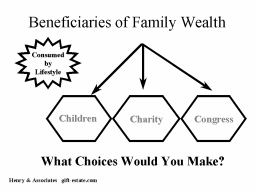 “Give my stuff to charity! What kind of crazy estate plan is that?” is a typical client response. When they ask about ways to eliminate unnecessary estate taxes and are told to make gifts during lifetime that’s an understandable reaction. It’s not intuitively obvious how giving away something the client may need can be a good thing, especially if the potential donor was raised during the Depression. The epiphany comes when the client looks at the choices they have for assets not consumed to support their lifestyle; those remaining assets can only go to children, charity or Congress. Once the options are explored, many people make a decision to pass some property to heirs and other things to charities that either had or will have some impact on their family’s life. How can they be smarter making that decision?
As it turns out, giving heirs assets that can be legally excluded from tax and leaving the rest of the estate to charity works if (and it’s a big if) tax avoidance and philanthropy are the only goals. It’s a simple, easy to understand process with no need for expensive tax planning or specialized legal advice. While this technique might shortchange family heirs, it is an ideal solution for charitably motivated families. However, even if the family has an altruistic desire to make a charitable gift, there’s no reason it can’t be done in a tax efficient manner. How so? Make those charitable bequests with assets that otherwise would be taxed twice. For example, in 2002 anything in excess of $700,000 is subject to a federal estate tax. A simple estate plan would be to sweep anything above that level to charity. A better plan would be to give away those assets on which an added income tax is owed. What qualifies? “income in respect of a decedent” (IRD) assets. Start with an IRA, a retirement plan account, a deferred annuity, and savings bonds; and don’t forget earned, but uncollected professional fees. This means a charity receiving $100,000 from that donated IRA collects the whole value without paying any tax. In the traditional estate plan, children might lose 75 percent if they inherited those IRD and tax-deferred dollars. Better to let family heirs inherit assets that “step up” in basis, so if they’re sold later, there won’t be much of an income tax due. The second plan is more tax efficient, as the charity receives more, the heirs get to keep more and the IRS gets zilch.
The problem is that without changes in beneficiary designations or specific language in the Will, the estate can’t make charitable gifts of income. Bequests are normally made from principal unless there has been a proactive decision to give away tax liabilities. Seek guidance from competent professional advisors to make sure these gifts are properly implemented, and do it now.
“If you don’t watch out, you can set up a situation where a child never has the pleasure of bringing home a paycheck.”
— T. Boone Pickens, Jr.
A good plan deals with concerns beyond tax efficiency; it must also meet the needs of the family. For instance, will the plan provide for proper management by underage or unprepared heirs? Has it been decided if there’s an upper limit on what heirs could or should receive? What does the concept of money mean to the client? How much is too much? Could an inheritance provide a disincentive to work and succeed? Does the plan try to pass assets to all heirs equally, or have past gifts and interactions been considered in an effort to be equitable? Since there’s more to a legacy than just money, the estate plan should include passing down a family’s value system and influence. How have the family’s core values been addressed in the master plan?
The problem is that few professional advisors like to deal with such intimate and personal questions. Most tax and estate planners spend years honing their analytical skills only to find that clients don’t create and implement estate plans for purely logical reasons. Instead, there’s an overriding emotional motivation that’s often unsolicited in discussions with client. The problem is that even an elegant estate plan that does everything it’s supposed to accomplish won’t be well received if the family doesn’t understand and agree with its goals. As a result, there’s paralysis by analysis, and nothing gets accomplished until both the logical and emotional needs for family continuity planning occur. Rather than try to plan an estate on an asset-by-asset basis, take a big picture view of the family’s goals and values and see how the planning can be made to meet those needs.
© 2000 — Vaughn W. Henry
 CONTACT US FOR A FREE PRELIMINARY CASE STUDY
FOR YOUR OWN CRT SCENARIO or try your own at Donor Direct. Please note — there’s more to estate and charitable planning than simply running calculations, but it does give you a chance to see how the calculations affect some of the design considerations. Which tools work best in which planning scenarios? Check with our office for solutions.